
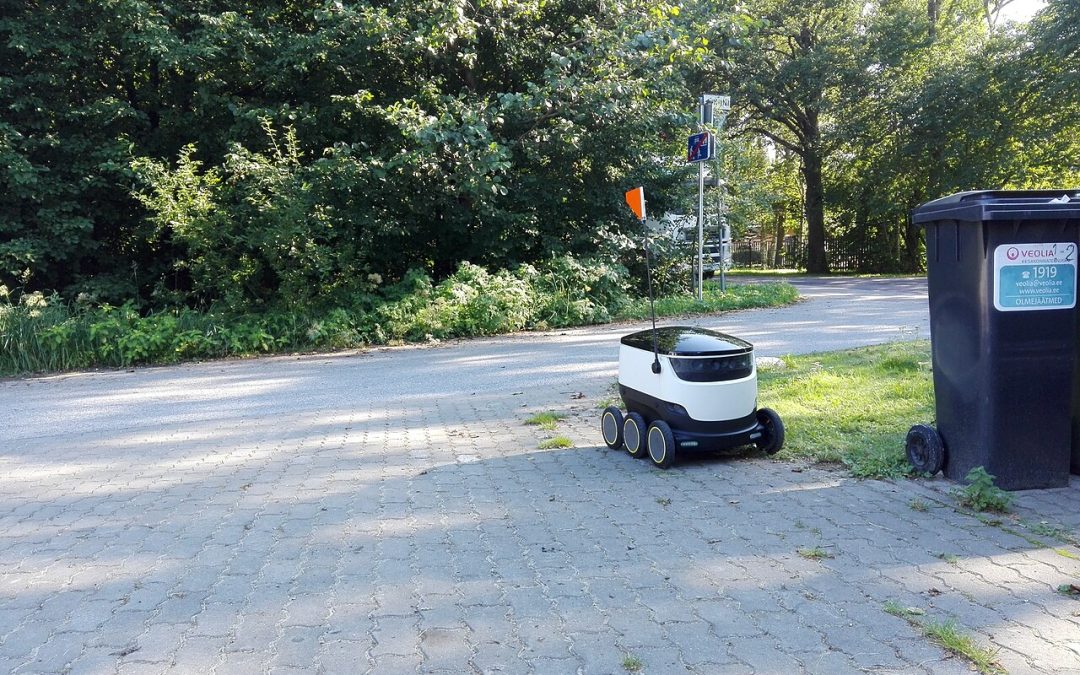
A delivery robot ran a red light in Tallinn on 26 October 2026. A city bus braked, struck the robot, and up to nine passengers were reported injured. The most revealing part is not the little machine being pushed along the road. It is what happened immediately afterwards—and what its manufacturer says about the safety software.
At about 6 p.m. on Monday, at the junction of Luise and Tehnika streets in Estonia’s capital, a Bolt-branded delivery robot entered a pedestrian crossing against a red signal, according to municipal transport operator Tallinna Linnatransport (TLT). The bus driver braked sharply. Standing passengers fell; TLT reported as many as nine injured. The bus still made contact with the robot and pushed it across the roadway. Estonian Public Broadcasting (ERR) reported the incident on 28 October.
Watch the actual incident footage: TLT bus-camera video, published in ERR’s original report. Another syndicated presentation is Reuters video carried by La Stampa on 29 October. These are links to the publishers’ players; the footage is not reuploaded by CANS.
Did the robot really flee the crash?
TLT initially said the robot left the scene after the collision. That understandably made headlines. But on 29 October, Starship Technologies’ head of operations, Pepe Aaviksoo, gave ERR a more specific account: the machine contacted a remote support team, which moved it off the carriageway to a safe position near the kerb. He said it remained nearby for approximately ten minutes.
The two accounts are materially different. A police investigation and the manufacturer’s internal review were still underway in the reporting available on 29 October. The exact decision sequence—and who commanded each movement—has not been independently established. ERR’s follow-up also reported that Starship expects safety improvements to be primarily software-based. The company has not publicly established a specific sensor, software or traffic-signal root cause in that account.
The lesson is bigger than one small robot
Modern autonomous machines make decisions in imperfect environments: changing lighting, occluded objects, pedestrians who change direction, radio dropouts and ambiguous right-of-way. A robot crossing a road is an unusually visible illustration of a familiar industrial engineering problem: how does a mobile machine decide that its next movement is permitted, not merely physically possible?
A safety design needs more than an object detector that spots a bus. It needs a defensible decision chain: recognise the restricted crossing, establish whether movement is authorised, treat low-confidence perception conservatively, enforce a safe-stop state and preserve enough time-stamped evidence to reconstruct what happened. A command to move away after an impact also requires explicit rules about who may issue it and where the machine can safely go. Those are engineering requirements to test, not claims about the design of this particular Starship robot.
The same questions apply inside a warehouse. An autonomous mobile robot (AMR) might obey its route plan and still enter a forklift lane at the wrong moment. A pallet might block the familiar path. A maintenance technician might stand where the original layout never expected anyone to stand. One successful demonstration tells you little about the hundreds of awkward situations that follow.
How CANS could reduce similar risks in an industrial AMR fleet
For a Malaysian factory introducing delivery robots, warehouse AMRs or autonomous material-handling systems, CansNEXUS and CANS industrial integration services can provide an operational visibility and assurance layer around the robot supplier’s control system. This is different from selling a dashboard as a safety device.
Start with the evidence: where the robot’s vendor interface permits it, collect time-stamped route transitions, speed, obstacle-detection events, localisation-confidence or diagnostic states, emergency-stop indications, lost-communication events, manual takeover, software versions and changes to exclusion zones. Correlate these with PLC/SCADA traffic-light or access-gate status and the site’s shift and maintenance records. A genuine near miss should become an investigation item, not disappear when the robot resumes moving.
Test the real hazards: use a plant-specific digital twin or simulation to exercise planned routes and intersections, then validate the results with physical site acceptance tests. Introduce stopped forklifts, moving people, obstructed crossings, poor visibility and controlled communication loss. Verify not only whether the machine stops, but whether it remains in the intended safe state and can recover only through an authorised process. A simulation is evidence for the test plan—not proof of physical safety by itself.
Make follow-up measurable: CansNEXUS event histories, OEE/downtime analytics and a connected CMMS can track recurring obstacle alarms, intervention frequency, overdue inspections, route modifications and post-event corrective actions. CANS’ PLC/SCADA and industrial communications engineering can help connect suitable fleet data, area controls and maintenance workflows without unnecessarily replacing a working robot platform.
Keep safety independent: protective-rated speed and separation monitoring, appropriate scanners, emergency stops, access interlocks, vehicle interfaces and site risk assessments must be designed and validated by competent safety engineers. Neither CansNEXUS analytics nor an AI inference model can guarantee that a robot will stop before an accident. The robot OEM must demonstrate the performance of its actual safety-related control system; any supervisory integration is supplementary.
A short acceptance test before the next robot goes live
- Identify every crossing between the robot route and people, forklifts, buses or other moving equipment; document who has priority.
- Prove safe stopping and recovery during loss of localisation, obstructed visibility, communications failure and an emergency-stop request.
- Record the evidence for each test: machine state, timestamps, software version, expected result, observed response and authorised sign-off.
- Re-test after route, firmware, traffic arrangement or operational changes; treat near misses as engineering findings rather than inconvenient statistics.
In Tallinn, the collision is documented and real. The detailed reason for the robot’s crossing decision remains under investigation. What other operators can do today is review how their own mobile machines obtain permission to move, how they handle uncertainty and how they prove it later.
Planning an AMR or autonomous warehouse deployment? Contact CANS or send our engineering team a WhatsApp enquiry. Share the robot model, vendor data interfaces, traffic layout and current PLC/SCADA arrangements so we can assess a practical monitoring and integration scope.
Sources, original footage and image rights
- Estonian Public Broadcasting (ERR), 28 October 2026 — local TLT account, location, time, injuries and bus-camera footage. Video credited to Tallinn Transport (TLT).
- ERR, 29 October 2026 — Starship Technologies’ explanation of remote-team handling and its planned software-focused safety improvements; collision under investigation.
- Reuters video syndicated by La Stampa, 29 October 2026 — additional collision footage; publisher retains video rights.
- Featured photograph: A Starship Technologies delivery robot photographed in Kakumäe, Tallinn, in August 2017 by Ohpuu / Wikimedia Commons. CC0 1.0 public-domain dedication. Resized copy used. Illustrative only: not the robot or the scene of the 26 October 2026 collision.
Recent Comments