
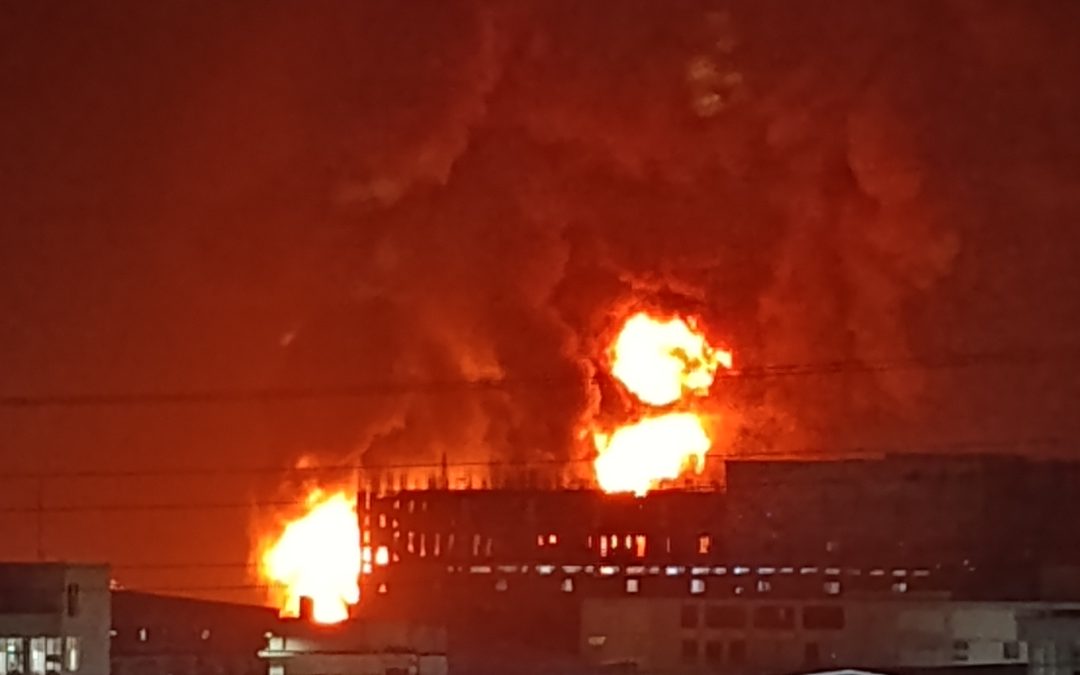
A battery factory caught fire near an acid tanker on Friday, 23 October 2026. Twenty-two fire-service vehicles and 52 personnel were mobilised. The fire was controlled after roughly 90 minutes; fortunately, no injuries were reported. The cause, however, was not established in the contemporaneous reports. For an automation engineer, that last detail matters as much as the flames.
The incident took place at İnci Akü’s facility in the Manisa Organised Industrial Zone, Türkiye. Demirören News Agency (DHA) reported that the fire was close to an acid tanker, and that the city fire department deployed 22 vehicles, 52 personnel and 12 water tankers, supported by industrial-zone crews. Local coverage quoted the mayor after a headcount confirmed that workers were not inside the affected area. There is no verified evidence in these reports that an acid tanker exploded, that battery cells entered thermal runaway, or that a specific electrical fault caused the fire.
Actual incident video: Watch TRT Haber’s Manisa battery-factory fire report and video, 23 October 2026. This is the news publisher’s original video page, credited to Anadolu Agency (AA); CANS does not own or re-upload the footage. For the subsequent firefighting details see DHA’s updated incident report.
Why the acid tanker detail matters — and what it does not prove
An acid tanker near a fire is an exposure to assess, not evidence that acid caused the ignition. A proper investigation must establish where the fire originated, the materials and plant involved, the electrical and ventilation conditions, and the sequence of alarms and actions. It would be irresponsible to declare this a lithium-ion thermal-runaway event merely because the word battery appears in the headline.
Battery-manufacturing areas can contain different hazards, depending on the actual chemistry and operations: charging equipment, power cables, hot machinery, combustible packaging, chemical storage, ventilation and vehicle movements. The correct fire-protection strategy starts with a site-specific hazard assessment. News footage cannot identify the defective component.
The less spectacular problem: did anyone have the right signals?
The useful engineering question is not whether a dashboard could have spotted these particular flames. We do not know what instrumentation the Manisa plant had. The question is what a similar factory should be able to detect, record and act upon before a small abnormality becomes a major incident.
For example, where lead-acid batteries are charged, hydrogen release is a recognised hazard. The US Occupational Safety and Health Administration calls for adequate ventilation to avoid hydrogen accumulation, together with ignition-source control and suitable charging-area precautions. The Canadian Centre for Occupational Health and Safety discusses ventilation arrangements designed to keep hydrogen well below its lower explosive limit. These are general engineering references, not a finding that hydrogen caused the Manisa fire.
How a CANS solution could reduce the risk at a similar plant
CANS can integrate industrial instrumentation, PLCs and SCADA with CansNEXUS industrial analytics, digital-twin displays and maintenance workflows. The useful design is a layered one:
| Risk or blind spot | Practical engineering response | Role of CANS systems |
|---|---|---|
| Ventilation fails in a charging zone | Verify actual airflow or fan proving, monitor suitable gas detectors where the hazard study calls for them, and protect the charging process with properly engineered independent interlocks. | PLC/SCADA records ventilation state, gas readings, trends and alarm events; CansNEXUS gives maintenance staff a common view. |
| Charger or electrical distribution develops abnormal conditions | Review charger current/voltage/temperature, protection-device status and equipment thermal inspections; investigate sustained abnormal patterns against manufacturer limits. | Condition and electrical telemetry, time-stamped alarms and diagnostic trends support faster troubleshooting. |
| Hazardous materials sit close to heat or ignition sources | Confirm separation, containment, fire zones, access, detection and the emergency response plan through competent fire and process-safety engineering. | Asset registers, location-aware digital-twin views and inspection records show what equipment and materials occupy each zone. |
| Maintenance evidence is incomplete | Track inspection of chargers, cabling, ventilation, gas detectors, extinguishing systems and emergency isolation; retain overdue and failed-test records. | CMMS integration associates each asset with the work order, evidence, abnormal alarm and responsible action. |
| An event escalates despite monitoring | Use certified fire detection, protection, emergency shutdown, evacuation and independently engineered safety functions suited to the hazard. | SCADA preserves a time-synchronised event trail for operators and post-incident investigation; the dashboard is not the safety controller. |
A simple but effective starting test: select one battery-charging or electrical utility zone, deliberately simulate a safe, approved ventilation-status fault using the site’s documented test method, then confirm the expected alarm, independent protective response where installed, operator acknowledgement, event timestamp and CMMS escalation. Never disable protective functions or create an actual hazardous atmosphere to demonstrate software.
What SCADA and AI cannot do
A trend, digital twin or AI anomaly score cannot guarantee that a fire will be prevented. An alarm which nobody hears is only a historical record with better graphics. For high-consequence hazards, risk assessment, trained operators, suitable physical safeguards, appropriately rated protective relays and independent interlocks remain essential. A CANS monitoring platform can improve visibility, traceability and intervention time; it must not be sold as a substitute for fire protection or safety engineering.
If the Manisa investigation later establishes a root cause, the recommended controls should be reviewed against that finding. Until then, claims that any one software product would have prevented this actual incident are not justified.
What to check in your own factory this week
Take one critical charging, chemical-handling or electrical room. Compare the hazard assessment against the installed sensor list; verify that ventilation and protective devices have recent functional-test evidence; inspect who owns alarm response after hours; and check whether the last abnormal event can be reconstructed from SCADA and maintenance records. If those records are fragmented, address that before adding more AI.
CANS works with existing plant systems to integrate instrumentation, PLC/SCADA, industrial communication, equipment monitoring and CansNEXUS maintenance and analytics. To review a specific monitoring or integration gap, contact CANS or WhatsApp the engineering team on +60 12-295 9602.
Sources, footage and photograph
- TRT Haber / Anadolu Agency, video report, 23 October 2026 — footage of the Manisa factory fire; linked, not reproduced.
- Demirören News Agency (DHA), Ersan Erdoğan, updated 23 October 2026 — 22 vehicles, 52 personnel, 12 water tankers, approximately 90 minutes, no injuries, fire near acid tanker; cause undetermined.
- Manisa Meydan, 23 October 2026 — local video and mayor’s statement on the worker headcount.
- US OSHA, electrical battery charging safety guidance — ventilation, hydrogen and ignition control in relevant charging areas.
- CCOHS, Battery Charging — Industrial Lead-Acid Batteries — ventilation and hydrogen-risk control guidance.
Featured photograph (illustrative only): A different factory fire photographed by Arman Sazid in Chittagong, Bangladesh, on 16 October 2025; Wikimedia Commons, CC BY-SA 4.0. The featured photograph does not depict the Manisa fire, and is not reproduced in the article body. Incident video copyright remains with its original publisher/rightsholders.

Recent Comments