
Rockwell Automation’s 21 October 2026 announcement of FactoryTalk Conductor marks a useful change in direction. Instead of asking a chatbot how to write PLC logic, the proposed system coordinates AI agents, engineering tools and project workflows. That is more interesting to an automation engineer than another demonstration of generated ladder logic. It also introduces a harder question: who proves that the changes are correct before they reach a machine?
Rockwell describes Conductor as an AI-native orchestration platform. Its public debut is planned for Automation Fair in Boston, 16–19 November 2026, with commercial availability expected in the first quarter of 2027. This is an announced product roadmap, not evidence that a production installation has already passed a customer’s factory acceptance test.
What Rockwell has actually announced
The stated launch integrations are Studio 5000 Logix Designer, Logix Echo, Emulate3D and FactoryTalk Optix. These cover control-system design, controller emulation, plant simulation and visualisation. Further integrations with FactoryTalk Design Studio, FactoryTalk Historian, Plex and Fiix are planned rather than launch commitments.
Rockwell also says engineers will be able to create their own agents and skills, choose among hosted AI services and compatible language models, including locally hosted open-weight models, and use natural-language instructions to initiate multi-step engineering work. That is a vendor description of intended capability; it does not establish accuracy, cycle-time savings or safety performance at a particular plant. Those still require measurement.
The distinction matters. A copilot offers a suggestion. An orchestrator may coordinate a chain of actions across several applications. If one step uses the wrong motor tag, the error can travel from a PLC change through an HMI display and into a test report. A beautifully formatted report will not make the motor run in the right direction.
Six acceptance gates for agent-assisted PLC engineering
- Freeze the engineering baseline. The agent must work against an identified controller programme, firmware revision, I/O schedule, tag database, electrical drawing set and approved functional specification. Every generated edit needs a human-readable difference and a route back to the previous version.
- Restrict write authority. Reading project artefacts and proposing changes is different from downloading code to a live PLC. Define separate permissions for analysis, editing, offline testing and deployment. Production writes should require explicit authorised engineering approval, with a maintenance window and recovery plan.
- Verify interfaces, not just syntax. Compile success is necessary but insufficient. Check data types, scaling, units, alarm limits, equipment states, permissives, start-up sequences and PLC–HMI tag consistency. For MES integration, verify work-order handshakes and the handling of missing or repeated messages.
- Exercise failure paths in simulation. Test communication loss, stale inputs, sensor disagreement, power recovery, a jammed conveyor and an operator’s manual override. Where simulation tools are available, compare expected state transitions against actual controller behaviour and retain the test evidence.
- Keep protective functions independent. Emergency stopping, safety interlocks and other protective measures must not depend on an unverified language-model response. Validate the safety architecture through the applicable machine-safety process, separately from an AI agent’s convenience features.
- Keep a reproducible audit trail. Record who asked for the change, the model or tool versions used, input documents, generated differences, test outcomes, approval and deployment identity. After commissioning, capture the actual downloaded programme checksum and a tested rollback procedure.
These are recommended engineering acceptance criteria, not claims that Conductor automatically implements all six. A buyer should ask the vendor or integrator to demonstrate each relevant control against the actual project workflow.
A realistic factory acceptance test
Take a small conveyor and sorting cell. The project includes a PLC, HMI, photoelectric sensors, motor drives, an alarm list and a production-order interface. Ask the AI workflow to add a new reject station while maintaining the existing electrical and operational constraints.
The acceptance evidence should include the proposed I/O and tag changes; programme and HMI differences; successful compilation; a repeatable virtual sequence for normal, manual and fault modes; tests for loss of the photoeye and the upstream-ready signal; and an independent review of the interlocks. The reviewer should be able to reject one part of the change without being forced to accept the entire package.
Then repeat the same request with an intentionally incorrect input—such as an obsolete I/O schedule—to establish whether the workflow detects the document conflict or confidently edits the wrong project. That is often a more revealing test than timing how quickly it generates code.
What this means for brownfield plants
Many factories in Malaysia and Singapore run mixed generations of controllers, proprietary HMI projects, serial gateways and locally modified machine logic. An AI orchestration layer can assist with cross-referencing documents, discovering discrepancies and preparing offline tests. It should not assume that every old controller exposes a modern API or that two machines using the same tag name share the same engineering meaning.
The OPC Foundation’s April 2026 initiative to make more than 430 OPC UA companion specifications usable by AI tooling is relevant here: machine-readable information models may help agents interpret industrial context. But semantic descriptions do not replace checking the actual field wiring, firmware or mechanical sequence.
There is also a security boundary. The ISA/IEC 62443 series treats industrial control-system cybersecurity as a lifecycle responsibility involving asset owners, suppliers and integrators. Agent credentials, engineering-station access, test environments and change records belong within that responsibility. A model’s ability to operate a tool is not itself authorisation to operate the plant.
For project teams, the sensible first use case is narrow: let the agent prepare a change set or test procedure for an offline controller project, measure review effort and defect rates, then expand only where the evidence supports it. The economic case is engineering hours saved after review and rework, not the number of tasks claimed by a chatbot.
The engineering bottom line
FactoryTalk Conductor makes multi-tool AI engineering a concrete product direction, with a preview due in November and commercial availability targeted for 2027. It is worth watching. The real competitive advantage, however, will come from the quality of verified domain knowledge, controlled project interfaces and repeatable testing—not from granting an agent more buttons to click.
CANS works across PLC/SCADA engineering, embedded systems and industrial integration and the CansNEXUS industrial digitalisation platform. For related background, see our earlier analysis of AI agents and the PLC write path.
Discuss an automation or industrial AI integration project: contact CANS or WhatsApp our engineering team.
Sources and image credit
- Rockwell Automation, FactoryTalk Conductor announcement, 21 October 2026 (launch scope, integrations and target availability).
- Rockwell Automation, Automation Fair 2026 event details (16–19 November, Boston).
- OPC Foundation, OPC UA for agentic AI initiative, 20 April 2026.
- International Society of Automation, ISA/IEC 62443 series overview (industrial cybersecurity responsibilities).
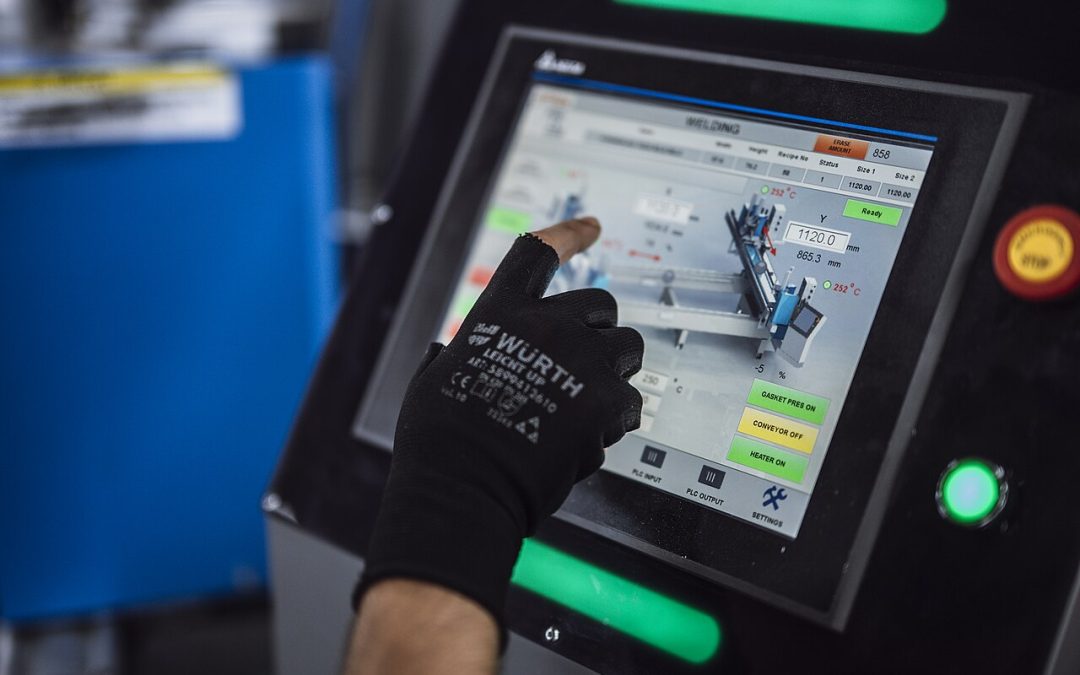
- Featured photograph: a machine operator using an HMI touchscreen, by Nenad Stojković (Wikimedia Commons contributor Shixart1985), source, CC BY 2.0. Illustrative photograph; not a FactoryTalk Conductor product demonstration.
Recent Comments