
22 October 2026 — Engineering analysis. A semiconductor assembly or test machine does not become obsolete simply because its controller predates the current enthusiasm for AI. Many older bonders, handlers, testers and inspection stations still do their job reliably. The problem is that their useful process information is often trapped in proprietary controllers, local PCs and maintenance notebooks. An edge AI retrofit can help, provided it is engineered around the machine rather than allowed to interfere with it.
Two current developments make this worth revisiting. SEMI’s August 2026 standards update describes a renewed focus on diagnostic data acquisition and explains the distinction between equipment-control interfaces and high-volume data acquisition. Separately, NIST released the initial public draft of SP 800-82 Revision 4 on 21 September 2026, with comments invited until 30 November. Neither is a licence to attach an unmanaged AI computer to a production network.
First, establish what the existing equipment already exposes
Start with the electrical drawings, I/O list, PLC programme version, machine PC, alarm history and available host interface. Older semiconductor equipment may offer SECS-II/GEM, HSMS, discrete signals, serial communications or a vendor-specific service port. Some newer platforms also support the SEMI Equipment Data Acquisition (EDA, or Interface A) standards. Check what is actually licensed, supported and safe to read; do not assume that a socket or serial port is an open integration interface.
SEMI E30 defines the GEM communications model for equipment behaviour, collection events, alarms and related functions. SEMI describes EDA as a parallel, higher-volume equipment-data interface rather than a replacement for GEM/SECS control. A practical retrofit should respect that separation: collect diagnostic information without unexpectedly taking ownership of machine commands or recipes.
Build a read-only evidence path before building a model
For an older die bonder or test handler, the first useful signals might be cycle start and completion, equipment state, vacuum level, pneumatic pressure, motor current, temperature, reject count and alarm codes. Sensors added for a retrofit need appropriate isolation, electrical protection and validation. A measurement that disturbs the existing signal is not an improvement.
Normalise the records at the edge. Each sample or event should carry a timestamp, machine identity, recipe or product context, operating mode, units, sensor health and, where relevant, lot or serial identifier. Account for clock drift, communication outages and missing records. Where the old controller has no reliable event clock, record both the source timestamp (if present) and the collector’s receive time, then document the uncertainty.
SEMI E10 provides an established vocabulary for equipment reliability, availability, maintainability and utilisation. SEMI E79 addresses overall equipment efficiency. Use those definitions before comparing performance across shifts, machines or sites. Otherwise the dashboard may be beautifully rendered but mathematically misleading.
Three sensible retrofit applications
- Condition monitoring: analyse motor-current, vibration, pressure or temperature trends to flag a change from an established machine baseline. Set alert limits with maintenance engineers and account for recipe changes and scheduled servicing.
- Inspection support: use vision or test signatures to identify suspect units for additional inspection. Record the model version, confidence, source evidence and final disposition. Do not quietly replace an approved test limit with an opaque classifier.
- Cycle and downtime analysis: associate machine-state transitions with actual production orders, lots and reason codes. This can reveal recurrent stoppages and bottlenecks even before an AI model is justified.
In all three cases, the model should initially run in shadow mode: it observes and records what it would have recommended while the existing validated equipment and operators remain in control. No result is claimed here for any CANS or customer installation.
Keep deterministic control and safety outside the AI loop
A sidecar industrial PC can acquire data, store-and-forward events during network outages and run inference locally. It must not become a hidden interlock, emergency-stop controller or unapproved recipe writer. Retain the original PLC/motion-controller authority and machine safety circuit. Where future closed-loop optimisation is contemplated, treat it as a separate change requiring hazards review, formal validation, rollback and approval by the equipment owner.
Fault-test the retrofit as thoroughly as the model: disconnect the edge PC, corrupt an input, fill its storage, interrupt the network, restart the application and restore a backup. The original production equipment should retain its intended safe operation. A monitoring solution that can stop a healthy machine by crashing has misunderstood the assignment.
Connect to MES without sacrificing traceability
Map machine events to manufacturing operations rather than sending an indiscriminate stream of tags into a database. ISA-95/IEC 62264 is useful for defining boundaries between equipment control, manufacturing operations and enterprise systems. Agree who owns the equipment identifier, recipe revision, work order, lot, unit disposition and time synchronisation. Store raw evidence where necessary, then expose validated events and exceptions to MES, maintenance systems or CansNEXUS.
A minimum acceptance dataset should include representative production, planned stops, changeovers, faults, abnormal sensor readings and controlled restarts. Agree in advance how the pilot will be judged: detection precision and recall, missed defects, false alarms per operating hour, event completeness, time alignment, additional operator effort, recoverability and lifecycle cost. The right metric depends on the machine and task; no universal AI accuracy percentage proves production readiness.
Apply OT security from the outset
The edge device is a new asset and a new attack surface. Put it on an appropriately segmented network, use least-privilege machine access, secure remote maintenance, maintain an asset and software inventory, manage patches and credentials, and test recovery. NIST SP 800-82 Rev. 3 remains the published guidance; the September 2026 Revision 4 is an initial public draft, not a final standard. The draft gives added attention to asset management, monitoring and protection of OT system-management functions.
There is also a procurement question. Who supports the edge hardware in five years? Who can reproduce a model, restore a configuration, replace a sensor or explain a disputed inspection result? If the retrofit depends on a single undocumented engineering laptop, it is simply another legacy system waiting to happen.
What to implement first
Choose one machine family and one operational problem. Carry out an interface and risk assessment, collect baseline data, prove read-only acquisition, run a bounded shadow-mode trial and review the evidence with process, maintenance, quality and OT teams. Only then decide whether further sensors, inference hardware or plant-system integration are justified. Replacing an entire machine may still be the better economic decision when its controls are unsupported or its mechanical condition is poor.
CANS can assess the interface and control boundaries through its industrial automation and SCADA engineering, AI vision inspection, industrial digitalisation and CansNEXUS integration capabilities. These are potential engineering services, not claims that a particular legacy test machine has already been retrofitted.
Discuss a legacy-equipment retrofit assessment: Contact CANS or WhatsApp the CANS engineering team.
Sources and photograph attribution
- SEMI, Standards Watch, August 2026: Diagnostic Data Acquisition Task Force (EDA versus GEM/SECS responsibilities).
- SEMI, Information & Control standards catalogue (E5, E30, E37 and EDA suite).
- SEMI, SEMI E10 equipment reliability, availability and maintainability overview (including relationship to E79 OEE).
- ISA, ISA-95 enterprise–control system integration.
- NIST, SP 800-82 Rev. 3, Guide to OT Security (published September 2023).
- NIST, SP 800-82 Rev. 4 initial public draft (21 September 2026; consultation closes 30 November 2026).
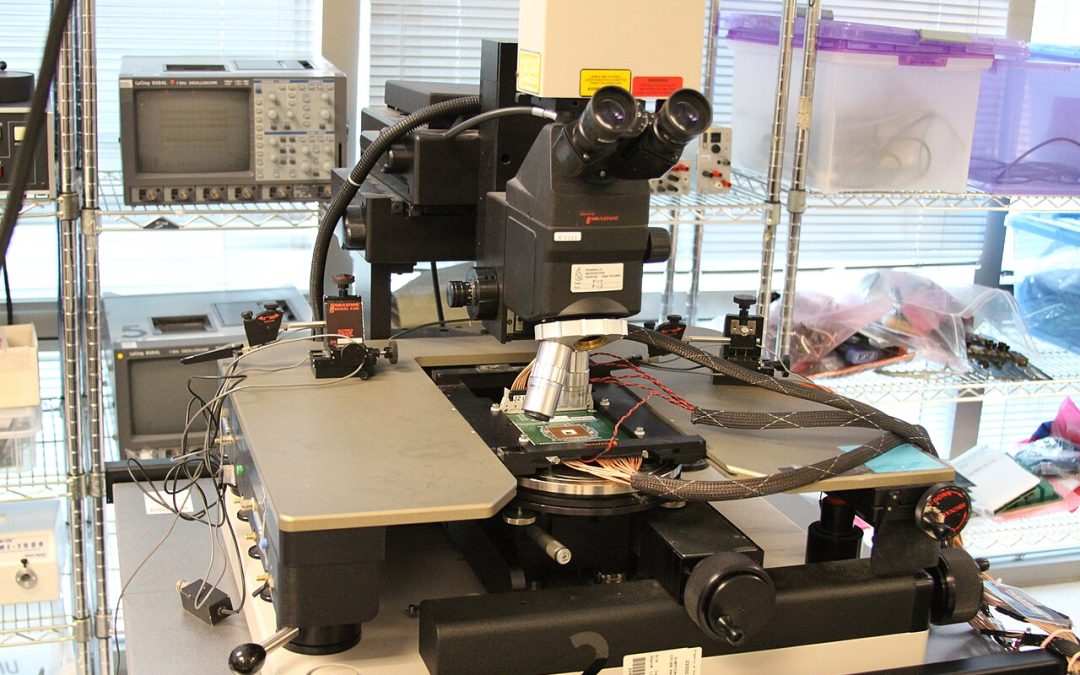
Featured photograph: Chip testing machine, photograph by Lenore Edman, 19 June 2013, via Wikimedia Commons, licensed CC BY 2.0. An illustrative equipment photograph, not a CANS retrofit or customer machine; displayed only as the featured image, not repeated in the article body. A reduced-resolution copy may be used for web delivery.

Recent Comments