
The AMR passed its commissioning tests. Then somebody moved the pallet buffer, changed a warehouse rule and parked a trolley beside the charging station. The robot is unchanged. Its workplace is not.
That is the useful engineering point in ANSI/A3 R15.08-3-2026, the 2026 standard covering the use of industrial mobile robot applications. A3’s product listing records publication on 23 April 2026 and explicitly emphasises risk assessment and management of change in both the application and its current operating environment. This is not simply a specification to file away after buying a robot. Read A3’s scope and publication details.
Commissioning is a starting condition, not a permanent guarantee
The R15.08 series separates the robot, system integration and continued use. ANSI’s explanation of Part 3 describes the user’s role in applying the manufacturer and integrator’s information, conducting risk assessment, maintaining risk-reduction measures and documenting changes after deployment. Training and safe work procedures are part of that operational picture. See ANSI’s overview of the user responsibilities.
For an engineering team, the practical question is therefore not whether a robot once worked safely. It is whether the assumptions behind that assessment still match today’s floor, loads, people and software. The examples below are engineering recommendations, not a clause-by-clause interpretation or a declaration of compliance.
Treat a route change like a control-system change
Suppose an AMR route is extended to a second production line. That looks like a few clicks in a fleet manager. In practice, it may introduce a blind corner, a forklift crossing, a different floor surface or a transfer point with less clearance. An updated map does not review those hazards for you.
A useful change record links the proposed route to the affected risk assessment, robot configuration, load envelope, operating restrictions and acceptance evidence. Record who approved the change and what was actually tested before releasing it. A screenshot of the new route is useful; it is not the whole engineering record.
The same discipline should apply to changing a top module, altering the payload, relocating a charger or modifying a conveyor interface. Keep a known approved configuration and a controlled restoration procedure. Test abnormal conditions under a planned, appropriately supervised validation procedure, not by improvising a hazard on a live production floor.
A warehouse order is not a safety permission
The WMS may ask for pallet 482 at station B. That request should not, by itself, authorise motion or override an interlock. Separate production scheduling from the safety functions identified by the risk assessment. An ordinary API response, dashboard flag or Wi-Fi connection should not be treated as a safety-rated control channel merely because it is convenient.
At the integration layer, give each transport job a unique identity. Distinguish accepted, executing, physically delivered, cancelled and failed states. Define which system owns the transition at each point. When a network timeout occurs, reconcile the robot and station state before sending a replacement job. Otherwise, an uncertain acknowledgement can become two movements for one request.
Consider the conveyor handover carefully. The fleet manager, station PLC and warehouse system need an agreed account of docking, transfer permission and transfer completion. Process permissives and safety interlocks are different things; the latter must retain their validated safety architecture. Recovery after a restart must not silently assume that a partly completed transfer has finished.
These are integration design decisions rather than a claim that Part 3 mandates a particular protocol. They are also why WMS, AS/RS and AMR integration deserves more attention than a successful demonstration run.
Use the digital twin to expose assumptions
A digital model can help compare routes, station occupancy and congestion scenarios before changing the physical installation. The useful output is not an attractive animation. It is a list of assumptions to verify: vehicle dimensions, load overhang, stopping behaviour, traffic priorities and people entering shared space.
Simulation does not replace validation on the actual equipment and site. Keep the model version alongside the released configuration, and record where measured behaviour differs from the model. Otherwise, the digital twin can become a very polished description of a factory that no longer exists.
Make the handover usable on the night shift
Our recommendation is to hand over a concise operating package: approved routes and configurations, relevant risk-assessment records, responsibilities for changes, inspection and maintenance instructions, training records, and clear escalation and recovery procedures. The person responding to a stopped robot should not have to reconstruct the design intent from an old commissioning email.
Review recurring stops, failed transfers and manual interventions as operational evidence. Do not optimise them away by weakening protective measures. If a route repeatedly causes trouble, investigate the route, traffic arrangement and application assumptions with the responsible safety and integration specialists.
For manufacturers planning AMR integration, start with the control boundaries and exception paths. CANS’s industrial automation and SCADA engineering and industrial digitalisation services are relevant to that systems discussion. Send an enquiry or contact CANS on WhatsApp with the equipment list, interfaces and operating constraints.
Sources and image credit
Source checks: 16 October 2026. A3: Part 3 scope and publication details; ANSI: industrial mobile robot applications and user responsibilities; ANSI Webstore: official standard listing. This article uses the publishers’ public summaries; it does not reproduce or claim a full assessment of the purchased standard. Applicable requirements must be established for the particular installation.
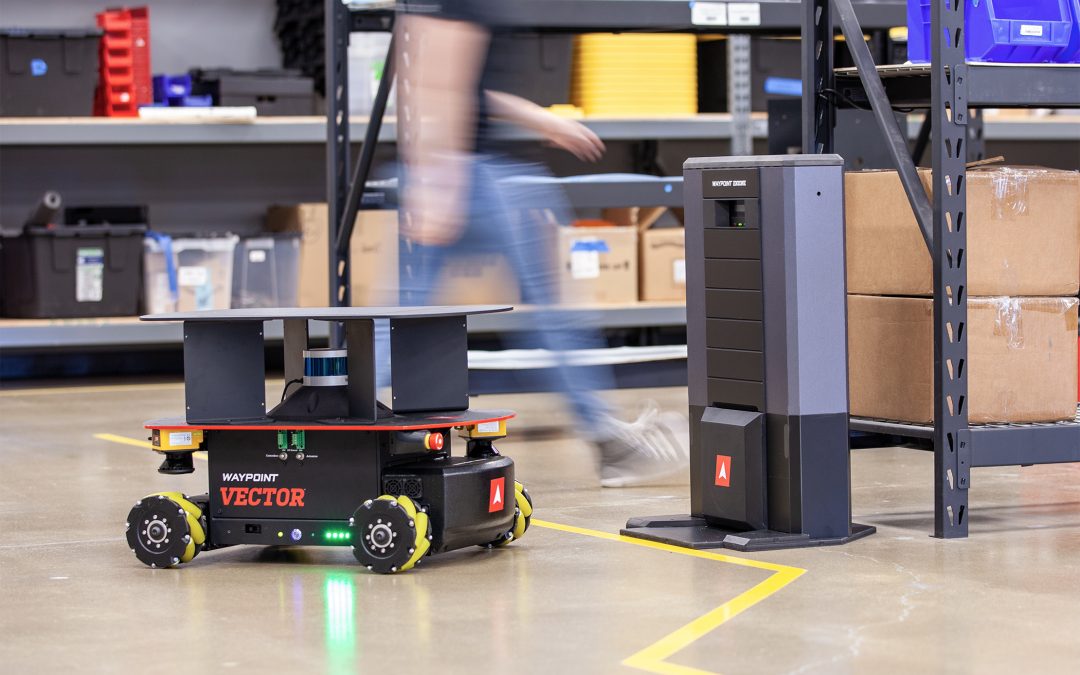
Featured photograph: Vector 3D HD mobile robot and EnZone charging station, PattyK33, Wikimedia Commons, CC BY-SA 4.0. Used as an illustrative photograph, not as a CANS installation or product endorsement. No editorial alteration; display sizes may vary.

Recent Comments