
PACK EXPO International 2026 opened at McCormick Place, Chicago, on 18 October and runs until 21 October. The organiser, PMMI, expects more than 2,700 exhibitors and over 150 educational sessions. Robots, intelligent inspection and increasingly capable packaging machinery will get plenty of attention. The less glamorous problem is making an entire line behave as one production system. PMMI’s 13 October show announcement sets out the scale of the event.
Rockwell Automation’s 5 October preview describes a planned demonstration bringing together control, production software, artificial intelligence, digital twins, robotics and autonomous logistics. This is a useful direction, provided the connections between those systems are engineered properly. Buying another dashboard is not the same thing as integrating a production line.
The PLC knows what happened; the MES needs to know what it meant
Consider a conventional line with a filler, capper, labeller, inspection station, case packer and palletiser. Each may have its own controller and perfectly reasonable operating logic. Yet the production supervisor wants a simple answer: how many saleable cases of product A were completed under work order B, from which materials, and where did the losses occur?
The controller should remain responsible for deterministic sequencing, interlocks and machine safety functions appropriate to the assessed risks. MES is concerned with work orders, production context, genealogy, quality disposition and the record of what was actually made. ERP should not become a machine-control layer merely because it owns the order number.
A practical interface exchanges explicit work-order identity, recipe revision, material lot, machine state, counters and events. It also establishes which system has authority to accept a job and when that acknowledgement becomes binding. An OPC UA, Modbus TCP or vendor API connection can carry these values; none automatically defines what they mean. That is the integration engineer’s work.
A handshake is not just two Boolean tags
Suppose MES requests a changeover from 250 ml to 500 ml packs. A reliable sequence needs more than a Start bit. The machine should identify the requested job, acknowledge acceptance, confirm the applied recipe and report whether it is ready, running, held, rejected or complete. If a timeout occurs, the supervisory system must determine whether the original request was accepted before sending anything again.
Assign a unique transaction or job identifier and persist its state across temporary communications loss. Treat a completed job as a durable event, not as a pulse that might disappear between PLC scans and application polling. Where several machines form one line, distinguish a local equipment fault from blocked or starved conditions induced by upstream and downstream equipment.
We have had decades to learn how to handshake a PLC. It would be unfortunate if the addition of AI persuaded us to forget.
Traceability starts at the physical handover
Packaging genealogy becomes unreliable when the software record moves ahead of the product. A barcode scan may indicate that a case reached a transfer point; it does not necessarily prove that the case passed inspection, was rejected, or entered the correct pallet. Those distinctions need physical confirmation and a clear owner for each state transition.
For high-mix food, pharmaceutical and consumer-product lines, record the relationship between the work order, SKU, recipe version, batch or lot, inspection outcome, individual case or pallet identifier, and actual machine events. Rejects, rework and manual intervention require proper disposition, not silent edits to the production count.
Where data cannot be collected at every station, be explicit about the resulting traceability boundary. A system that admits a gap is more credible than one that draws a continuous line through missing evidence.
OEE will not improve until everyone counts the same thing
Availability, performance and quality are straightforward concepts; their measurement is less straightforward. Does a waiting case packer count as a breakdown, starvation or planned stop? Which machine sets the line’s ideal cycle time when the bottleneck changes? Does a rejected pack count against the filler, the inspection station or the line as a whole?
Define production states, stop reasons, shift boundaries, planned downtime, good counts and reject counts before building the OEE screen. Capture raw events and preserve their original timestamps; calculate reports from versioned business rules so that definitions can change without rewriting history. CANS discusses these distinctions further in its OEE monitoring and production-efficiency services.
For existing equipment, an edge gateway can buffer events with monotonic sequence numbers and timestamps, then replay them after a network interruption. The MES must deduplicate those records. Otherwise the network recovers, the line apparently produces twice as many cartons, and somebody celebrates an unexpectedly successful improvement programme.
Digital twins belong above sound machine logic
A digital twin can examine accumulation, line balancing, material flow and the effect of changeovers before those changes reach production. That is different from permitting a simulation or general-purpose AI agent to override a safety interlock or directly command hazardous motion. Separate the advisory and optimisation layer from the approved real-time control functions.
Start with a faithful model of actual machine states, queues, cycle-time distributions and the constraints between stations. Validate it against measured production behaviour. Only then use it to evaluate buffer sizes, routing changes or likely throughput. A visually impressive model with imaginary downtime and perfect material availability is an illustration, not an engineering result. For relevant implementation work, see CansNEXUS industrial digital twins and AI.
What to do with an existing packaging line
There is no need to replace every machine before starting. Select one line, agree its production-state model, connect its critical PLC events, establish a small set of trustworthy counters and tie those to real work orders. Prove the stop classifications against operators’ records and test how the system recovers from lost communications and duplicate requests. Then extend the same contract to traceability, maintenance and optimisation.
For Malaysian manufacturers, the worthwhile lesson from PACK EXPO is not that the newest machine is clever. It is that machine intelligence becomes commercially useful only when production records, interfaces and responsibilities remain consistent across the whole line. CANS provides PLC and industrial automation integration, MES integration and CANiS middleware for connecting existing production equipment and enterprise systems.
To discuss PLC–MES integration, OEE instrumentation or a packaging-line digital twin, contact CANS or send an engineering enquiry on WhatsApp.
Sources: PACK EXPO International 2026 official show information; PMMI, 13 October 2026; Rockwell Automation, 5 October 2026. The integration recommendations are CANS engineering commentary, not claims that particular equipment or projects were demonstrated or commissioned at the show.
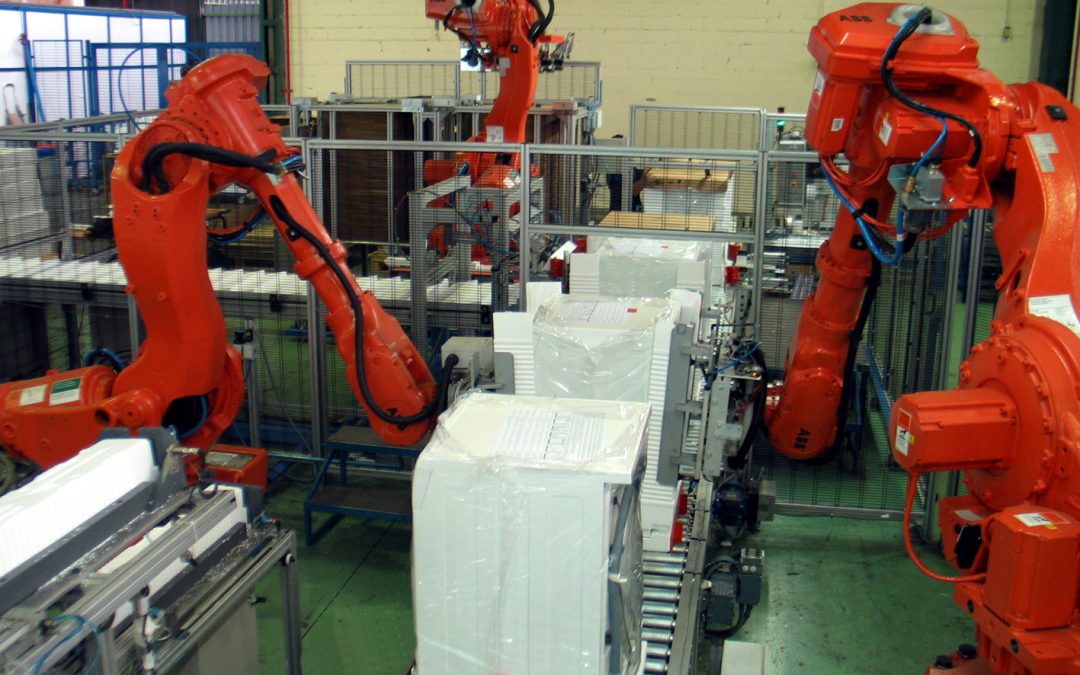
Featured photograph: automated packaging by industrial robots, photographed in 2013 by Tecnowey / Wikimedia Commons, CC BY-SA 3.0. Illustrative photograph; not a photograph of PACK EXPO International 2026.
Recent Comments