
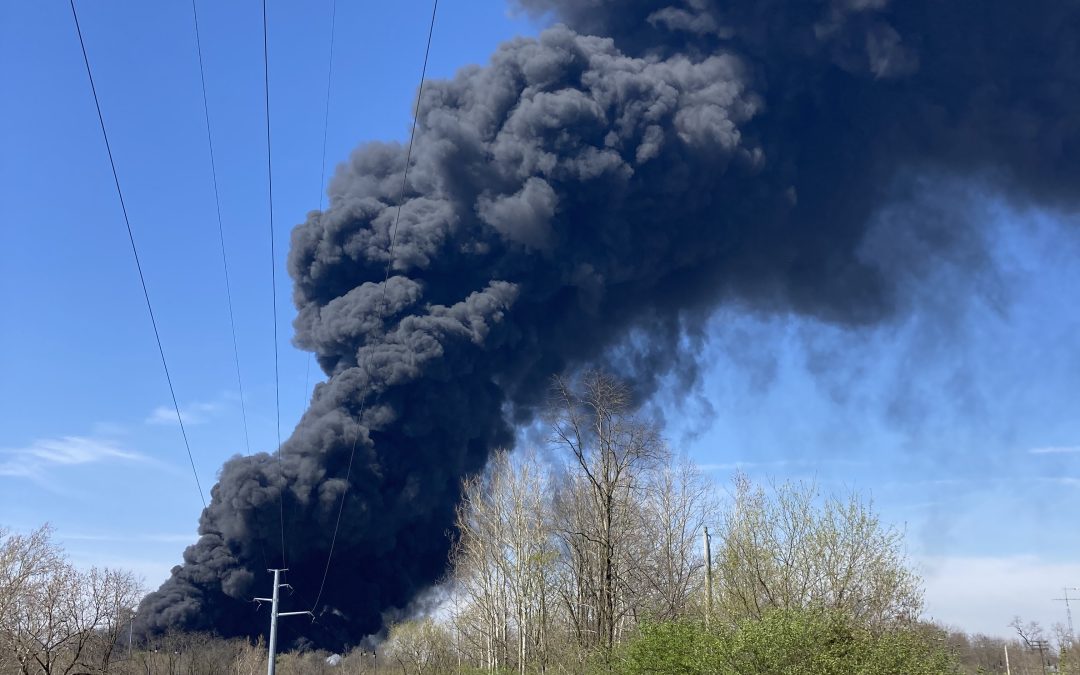
At about 1:05 a.m. on 31 October 2026, a fire swept through adjoining factories in Houhu, Linkou, New Taipei City, Taiwan. Five industrial buildings were affected across an estimated 5,000 square metres. Fire services dispatched 66 vehicles and 148 personnel. Six workers escaped and were taken for medical assessment. The scale of the response tells a story that deserves more attention than another headline about a factory blaze: when several workshops sit side by side, one emergency can become everybody’s emergency.
What started the fire has not been established in the reporting reviewed. Neither the footage nor the presence of plastics, furniture or workshop machinery identifies the ignition source. But the spread, emergency access and water-supply challenges raise questions that factory owners elsewhere should recognise.
Watch the fire: original broadcaster video
Watch Formosa TV (FTV) News’ 54-second report, published 31 October 2026 — official broadcaster YouTube video. The programme shows the reported fire scene. This is a broadcaster-produced video report, not authenticated continuous CCTV of the moment ignition began; it cannot establish the initiating failure.
According to contemporaneous Taiwanese reporting quoting New Taipei’s fire service, flames affected five linked metal-clad factories. The businesses included mixed manufacturing or workshop activities; accounts mention plastics, furniture, stone and kitchen-related work. Six people escaped and were taken for examination, with reporting varying on whether any had minor burns. The fire was reported contained around 3:07 a.m. and extinguished by approximately 3:53 a.m.
TVBS reported that narrow access roads and limited water supplies complicated the firefighting operation. United Daily News also described strong winds and smoke affecting neighbouring districts. Those are reported operational conditions, not an investigative finding about the cause.
Five premises, one shared exposure
The obvious question is whether any one factory had an adequate fire alarm. The less obvious question is what happens after that alarm: who else receives it, how quickly do neighbouring occupants know, and can the fire be contained before it crosses from one tenancy to the next?
Think of a row of workshops sharing close rooflines, service routes, cable trays and delivery access. Each occupant may have its own electrical panels and maintenance contractor. Yet flames, smoke, access restrictions and water demand do not respect the property boundaries. That makes fire compartmentation, appropriate automatic detection and suppression, dependable firewater and coordinated evacuation more consequential than an impressive control-room graphic.
It would be wrong to claim that a missing sensor, a defective sprinkler or an overloaded motor caused the Linkou fire. None has been established. Instead, the incident is a useful prompt to audit the controls that a comparable industrial cluster actually has.
How a CANS solution could reduce this risk
1. Connect the alarms without replacing the protection
CANS can engineer PLC/SCADA, instrumentation and building-system integration so that authorised alarm status from each premises’ approved fire-alarm system appears in a shared, timestamped operations view. A suitably designed CansNEXUS dashboard could identify which building raised an alarm, whether a critical signal has been acknowledged and whom to contact. Proper fire-alarm panels, local sounders, evacuation signalling and any life-safety actions must work independently of the SCADA network, cloud link or dashboard.
2. Watch the equipment that could give an early warning
For equipment where failures have measurable precursors, plant-specific monitoring can track switchboard temperatures, motor current, drive faults, fan status, abnormal energy consumption or vibration. CANS condition-monitoring and industrial data integration could route a genuine abnormality into an inspection work order before a fault develops. The measurements and alarm thresholds require engineering validation. A vibration trend does not detect every ignition source, and neither PyXis nor an AI model is a universal fire detector.
3. Make emergency access and utilities visible
A site-specific 2D/3D industrial map can identify fire zones, emergency exits, firewater assets, isolation points, access routes and adjacent risks. Where properly instrumented, firewater-tank levels, pump states, valve positions and pressure readings can be monitored as operational readiness information. This is relevant when emergency crews face narrow approaches or limited water, as reported at Linkou. The digital twin cannot widen a road, install a sprinkler or supply missing firewater; engineering works and emergency planning must do that.
4. Turn inspections into traceable actions
Link fire-alarm testing, fire-pump maintenance, electrical inspections, housekeeping, hot-work permits and evacuation drills to accountable work orders and due dates. CansNEXUS/CMMS integration can show overdue safeguards by building and preserve evidence of the corrective action. The most useful screen is often the one that tells a supervisor which critical test has not been completed.
What must remain outside a dashboard
Physical separation and fire-resistant construction, suitable detection and suppression, emergency lighting and exits, electrical protection, isolation and an adequate water supply require qualified design, installation, inspection and maintenance. Applicable local codes and the site’s fire-risk assessment govern these measures. A general-purpose SCADA or AI system should not be treated as the life-safety controller.
For context, US OSHA’s fire-prevention guidance calls for identifying significant fuel and ignition sources, installed protection systems and responsible maintenance personnel. Its woodworking safety guidance also highlights housekeeping and the potential fire hazards of wood dust, finishes and solvents. These are general engineering references, not Taiwanese legal requirements or an assertion about conditions inside the Linkou factories.
A 30-minute check for industrial estate operators
Walk the boundary between two neighbouring workshops. Identify who owns the detection system in each building, how a confirmed alarm reaches the next tenant, whether fire barriers and evacuation routes are unobstructed, how the emergency services can enter, and where the last tested firewater readings are recorded. Then trace a failed weekly or monthly inspection through to a closed corrective action. A system drawing is useful; a witnessed test and a current record are better.
Could CANS have prevented this specific Linkou fire? There is no evidence to say so. CANS did not investigate or supply the affected site, and the initiating cause is unknown. For similar facilities, however, well-engineered monitoring, cross-building event visibility and maintenance traceability can complement the independent fire-protection measures that actually limit harm.
For industrial-estate alarm integration, plant SCADA, operational digital twins and maintenance evidence workflows, review CANS project experience, contact the engineering team or enquire via CANS WhatsApp. Any proposal requires a site-specific fire-risk assessment and agreed technical scope.
Incident sources, video and photograph rights
- Formosa TV News, 31 October 2026 — original broadcaster video report; individual camera ownership and the first ignition moment have not been independently verified. Video linked, not reuploaded.
- United Daily News, 31 October 2026 — five factories, reported area and six evacuated workers; fire-service details.
- TVBS News, 31 October 2026 — 66 fire vehicles, 148 firefighters, narrow roads, water access, containment and extinguishing reports.
- US OSHA, Fire Prevention Plan and Woodworking Fire and Explosion — background engineering references.
- Featured photograph: industrial smoke plume from a different fire in Richmond, Indiana, photographed on 11 April 2023 by 28bytes, Wikimedia Commons source, CC BY-SA 4.0. Reused with attribution; WordPress may scale the original. Illustrative only — not footage or a photograph of the 2026 Taiwan incident.
Recent Comments