
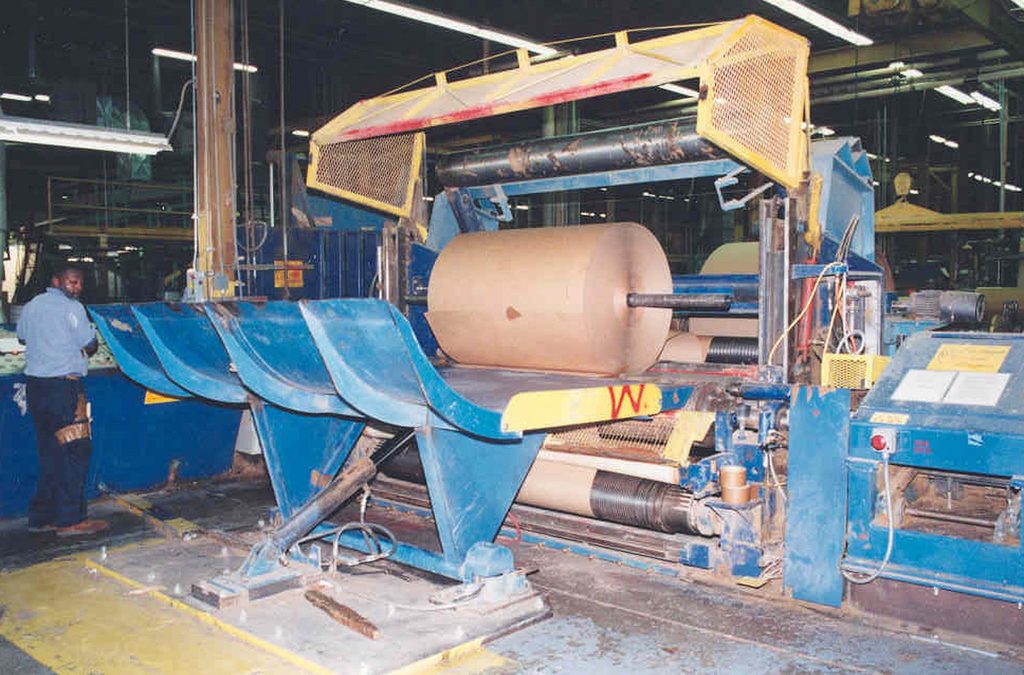
Bentong, Pahang — A maintenance job at a paper mill ended in a worker’s death. Police said a 32-year-old employee was found trapped in industrial machinery at Bentong Industrial Park, near Karak, following an emergency call at 11.56 pm on Tuesday, 27 October 2026. The case was reported on 28 October and classified as sudden death while the exact circumstances remained under investigation.
The immediate engineering question is not whether the operator pressed the stop button. It is whether every hazardous source of energy was positively isolated and verified safe before anyone entered the machine’s danger zone. There is no public evidence yet that an isolation procedure, guard or interlock failed in this particular case. That distinction matters.
Watch the original news report — not incident CCTV
Astro AWANI: “Pekerja maut tersepit dalam mesin di kilang kertas” (29 October 2026). The broadcaster’s original Malay-language video reports the police account. It must not be described as verified footage of the entrapment; no independently authenticated accident-camera recording was identified. The same AWANI report is available through its official Dailymotion channel.
According to Bernama reporting carried by theSun on 28 October, responding officers found the worker unconscious and trapped in a machine. The police expressly asked the public not to speculate about the cause. Reports do not establish which machine was involved, whether it was energised, what work was under way or whether a protective device was defeated. None of those can responsibly be inferred from a headline.
A stopped machine can still be dangerous
A PLC stop command normally stops a process in its intended operating sequence. It does not automatically prove that the machine is physically isolated, that stored energy is gone or that a moving assembly cannot start again. In a paper mill, danger may come from rotating rollers and in-running nip points, accumulated tension, a moving or suspended assembly, compressed air, hydraulic pressure, a coasting drive, or electrical energy remaining after a drive is stopped.
The UK’s Health and Safety Executive, in its industry-specific Making paper safely (HSG279) guidance, treats papermaking machine and task hazards as a specialised risk-management problem. The US OSHA hazardous-energy control standard, 29 CFR 1910.147, likewise separates normal operation from servicing and requires defined energy-isolation procedures, personal lockout where applicable, control of stored energy and verification of isolation before work. These US rules are cited as engineering reference, not as a statement of Malaysian legal obligations.
Malaysia’s own Department of Occupational Safety and Health has published lockout/tagout (LOTO) information. A risk assessment and equipment-specific safe system of work remain essential. A safety-rated guard interlock or drive Safe Torque Off function can be an important protective layer, but neither should be casually treated as a substitute for physical hazardous-energy isolation during invasive maintenance.
What should a maintenance team actually verify?
Before accessing a hazardous area: identify every relevant energy source; stop the equipment using the approved sequence; isolate and secure the appropriate energy-isolating devices; apply the required personal locks and identification; dissipate or restrain stored energy; and verify the safe state using an equipment-specific, competent-person procedure. A control-screen indication is supporting information, not proof of zero energy.
Before restarting: confirm the machine is intact, guards and protective functions are restored, tools and personnel are clear, every authorised person has completed their lockout release process, and the startup is communicated and controlled. For multi-person or multi-shift maintenance, the handover and group-lockout arrangements matter as much as the machine logic. The OSHA guidance addresses these steps explicitly.
Most plants can show a maintenance schedule. Fewer can quickly produce a complete, time-ordered record showing who authorised a hazardous job, which isolation points were identified, how the safe state was checked, what alarms occurred and when the line was released back into production.
How CANS could help reduce similar risks
A credible CANS industrial automation and CansNEXUS integration project would not begin by asking an AI system to decide whether a person is safe. It would begin with a machine-specific risk assessment and an independent protection design, then make the operational controls and maintenance evidence harder to overlook:
- Know the assets and isolation points. Map critical drives, motors, guards, valves, stored-energy sources and authorised isolation procedures in the plant’s asset register or digital-twin context. Keep engineering drawings and isolation instructions controlled and current.
- Make the work order auditable. Link a CansNEXUS maintenance or CMMS workflow to approved permits, assigned personnel, verified equipment isolation records, outstanding defects and recorded handover. Digital acknowledgements can strengthen traceability but do not replace the physical lock and independent field verification.
- Correlate machine state and alarms. Through PLC/SCADA integration, where available, trend maintenance mode, guard status, drive speed, motor current, motion commands, safety-system diagnostics and changes in equipment state. A mismatch such as a maintenance-mode indication with unexpected measured motion warrants investigation. Ordinary SCADA displays and software alarms are not safety-rated isolation devices.
- Engineer safeguards separately. Qualified machine-safety engineering may require fixed or interlocked guarding, suitable safety-rated monitoring, mechanical restraint, protective devices and verified hazardous-energy isolation. These layers must be independently designed, validated and maintained; a digital twin or vision model cannot guarantee protection.
- Learn from near misses. Link abnormal machine-state events, permit deviations, incident reports and corrective actions to CMMS work orders. Review repeated maintenance access, bypass requests, unexplained restarts and overdue protective-device tests before a serious event forces the review.
Could any particular CANS system have prevented the Bentong fatality? The investigation has not established the failure mechanism, so that claim cannot be made. Properly engineered, independently verified isolation and safeguarding can reduce well-understood machinery hazards; integrated monitoring and maintenance records can help operators see and address gaps. They play different roles and neither should be confused with the other.
Three questions worth putting to the plant team today
Can the team identify every electrical, pneumatic, hydraulic and mechanical energy source for the next planned machine-entry job? Can each authorised maintenance worker demonstrate personal isolation and a verified safe state without relying on the HMI? Can management retrieve the permit, machine-state history, protective-device inspection and return-to-service evidence afterwards?
If the answers are uncertain, start with the physical safety procedure and independent engineering assessment. Then use industrial data integration to maintain the records, surface exceptions and verify that corrective actions actually close.
CANS supports industrial controls, machine-data integration, SCADA monitoring and digitalisation projects for manufacturers. For a practical review of maintenance traceability, machine-state monitoring and the interface with independent safety safeguards, contact CANS or enquire via CANS WhatsApp. The scope and suitability of any solution require a site-specific engineering assessment.
Sources, video provenance and image rights
- Bernama via theSun, 28 October 2026 — reporting of the Bentong police statement and investigation status.
- Astro AWANI, 29 October 2026 — broadcaster-origin video report (not authenticated CCTV of the accident).
- UK HSE, Making paper safely, HSG279 — paper-machine hazard and task-management guidance.
- US OSHA, 29 CFR 1910.147 — hazardous-energy control and lockout/tagout reference.
- Malaysia DOSH, Lockout/Tagout infographic — local occupational safety resource.
- Featured photograph: industrial paper rolling/cutting machinery photographed by the US National Institute for Occupational Safety and Health (NIOSH), 2003, via Wikimedia Commons. Listed under CC BY 2.0 and US federal public-domain status. Reproduced without alteration. Illustrative only; this is not the Bentong mill or incident machinery.
Recent Comments