
On 5 November 2026, Panasonic Holdings announced a robot-manipulation research system that makes an unusually practical point about machine intelligence: the fingers need to react faster than the vision model. Its T-Rex (Tactile-Reactive Dexterous Manipulation) combines a roughly 5 Hz vision-language motion generator with 20 Hz tactile action correction. On 12 selected, contact-rich tasks, the researchers report a 65% average success rate, compared with 35% for their strongest comparison method. Removing tactile information from T-Rex reduced its score to 42%.
This is not a commercial Panasonic production robot or evidence of a deployed factory installation. It is a research result from Panasonic R&D Company of America, UC Berkeley, NVIDIA, Stanford, Sapienza University of Rome and ItalAI. Its paper was first submitted on 15 June 2026; Panasonic’s announcement is dated 5 November, ahead of a presentation scheduled for 9–12 November at the Conference on Robot Learning (CoRL) in Austin, Texas.
Watch the original researchers’ demonstrations
Original research team’s T-Rex demonstration gallery — watch the real robot manipulate objects. The project site offers task-selectable videos showing page turning, transferring an egg, unlocking a lock, pulling a card and screwing in a lightbulb, alongside examples of unsuccessful attempts. This is the authors’ own project and footage, not a third-party incident clip or an industrial production-line trial. Individual recordings are not separately dated on the accessible project page, and the original camera operator is not identified. We link to the research team’s player; no footage has been copied or reuploaded.
There is a useful detail here: a robot can align its hand perfectly in the camera image and still apply the wrong force when a part begins to slip, deform or catch on an edge. That is precisely the gap a tactile feedback path is meant to address.
Two clocks, not one enormous AI loop
A conventional vision-language-action (VLA) policy uses images and an instruction to produce a sequence of robot movements. It is capable of deciding broadly what to do, but generating a new image-driven action can be too computationally expensive for every tiny contact correction. T-Rex separates the responsibilities:
- About 5 Hz: the slower vision-language pathway plans broad movement using camera context and the task instruction.
- About 20 Hz: the tactile expert refines movement from fingertip force, torque and contact deformation, without re-running the complete vision computation every time.
- Lower-level actuation is separate: the research platform also describes a 300 Hz low-level control thread. Do not mistake the 20 Hz AI correction rate for the motor servo rate, nor for a certified safety response.
That is a familiar engineering pattern in a new setting: reserve time-critical feedback for a smaller, faster control path, while heavier perception and planning run at a lower frequency. But the resemblance to nested PID or cascaded control must not be overstated. The T-Rex tactile expert is a learned action-correction module, not a drop-in industrial PID loop, and its stability, latency and safe operating envelope still need application-specific validation.
The researchers’ architecture is a variable-rate mixture of transformer experts with an asynchronous tactile-refinement stage. A temporal tactile encoder captures both changing force/torque and spatial contact information. The reported training data include over 7,700 bimanual episodes totalling about 100 hours, with more than 200 objects and 22 short motion primitives; the system also benefits from extensive human first-person video pre-training. These are the team’s published training figures, not independently established deployment performance.
What the figures really prove — and do not
The group evaluated 12 contact-rich tasks with 16 randomised trials per task, reporting a 65% macro-average. The strongest cited baseline scored 35% and the no-touch T-Rex ablation scored 42%. Those are substantial differences within this benchmark; they do not mean every industrial manipulation task is now 65% reliable, or that tactile control always produces a 30-point improvement over a properly engineered application-specific robot.
In fact, the original project’s per-task table shows why engineers should look below the headline: turning a page reached 96%, transferring an egg 75%, and screwing in a lightbulb only 35%. The same project openly documents failure modes including a bulb colliding with its socket, a key slipping, imprecise egg placement, excessive toothpaste pressure and card-removal misalignment. It also identifies sensor calibration drift, limited palm sensing and difficult tightly-toleranced, long-horizon tasks as open problems.
That candour matters. Real automation is evaluated on repeatability, recovery, cycle time, rejected parts, maintenance effort and safe fault handling — not only on whether a polished demonstration eventually finishes.
What a Malaysian machine builder can take from this
Consider a cell inserting flexible connectors, placing fragile parts, handling rubber seals or screwing components into housings. Vision can find the target, but camera images alone may not reveal contact force or the moment a part starts binding. A practical engineering design could use an end-effector force/torque sensor, tactile pad, motor-current feedback or displacement measurement, depending on the actual process. It would then distinguish normal assembly contact from misalignment, excessive insertion force and repeated unsuccessful attempts.
Start with a measurable process requirement: acceptable insertion-force profile, positional tolerance, allowable deformation, cycle time, defect categories and safe stopping distance. Timestamp the command, measured force, position, grip state, PLC state and vision/inspection result; correlate them by part serial number and recipe revision. Only then choose whether a learned tactile model earns its complexity over a simpler force-control or compliant-mechanism approach.
A 65%-successful research task is not an acceptable production yield. The engineering opportunity is in using touch and robust recovery logic to move a repeatable process towards the plant’s actual acceptance criteria.
How CANS could support a comparable industrial cell
Engineering and early detection: CANS can assist with embedded sensor interfaces, signal conditioning, industrial communications and PLC/robot integration so a cell records force, actuator position, drive current, grip state, camera confidence and cycle timestamps. The data path could run over a suitable real-time control interface, while CAN/CAN FD or industrial Ethernet carries diagnostic data where latency and bandwidth permit. Sampling, time synchronisation, sensor calibration and noise rejection are design requirements, not assumptions.
Risk reduction and quality: verified force/position envelopes and controlled retry rules can identify a jam, insertion mismatch or unexpected grip release. A machine-vision inspection step can flag missing or damaged components. A properly engineered PLC/robot controller should execute the defined stop/retract/reject sequence; a supervisory AI dashboard must not be the only decision-maker. For a high-volume assembly cell, CANS can integrate these events into CansNEXUS MES/OEE, diagnostic trends and part genealogy so quality engineers can see whether a specific recipe, gripper, shift or batch is driving rejects.
Independent safety protection: a suitable safety-rated controller, emergency-stop architecture, safe torque off, guarding, interlocks, force/speed limitations and validated collaborative operation remain separate from general-purpose AI, a SCADA screen or a digital twin. The required protective measures depend on a machinery risk assessment. A 20 Hz learned tactile correction is not a safety-certified protective function.
Maintenance and recovery: CANS PLC/SCADA integration can log abnormal-force trends, failed pickup attempts and actuator faults for maintenance follow-up. CansNEXUS dashboards and CMMS workflows could connect repeated deviations to gripper wear, sensor drift, lubrication or misalignment — but only if the relevant instruments and trustworthy machine-state signals actually exist. Neither software nor AI guarantees elimination of scrap, downtime or injury.
For an application-specific feasibility review, including sensing, control architecture, communications, independent safeguards and production traceability, contact CANS or enquire via WhatsApp.
Sources, footage and photograph credit
- Panasonic Holdings, English-language announcement, 5 November 2026 — original corporate statement, study design, numerical results and anticipated CoRL presentation.
- Dantong Niu et al., T-Rex: Tactile-Reactive Dexterous Manipulation (arXiv:2606.17055) — original research paper; submitted 15 June 2026, revised 18 June.
- T-Rex research-team project page — primary architecture detail, original task demonstration videos, per-task results and explicit failure examples. The page does not authenticate a separate date for each recording.
- AI Watch (Japan), 5 November 2026 — independent publication confirming the Panasonic announcement and its stated technical findings.
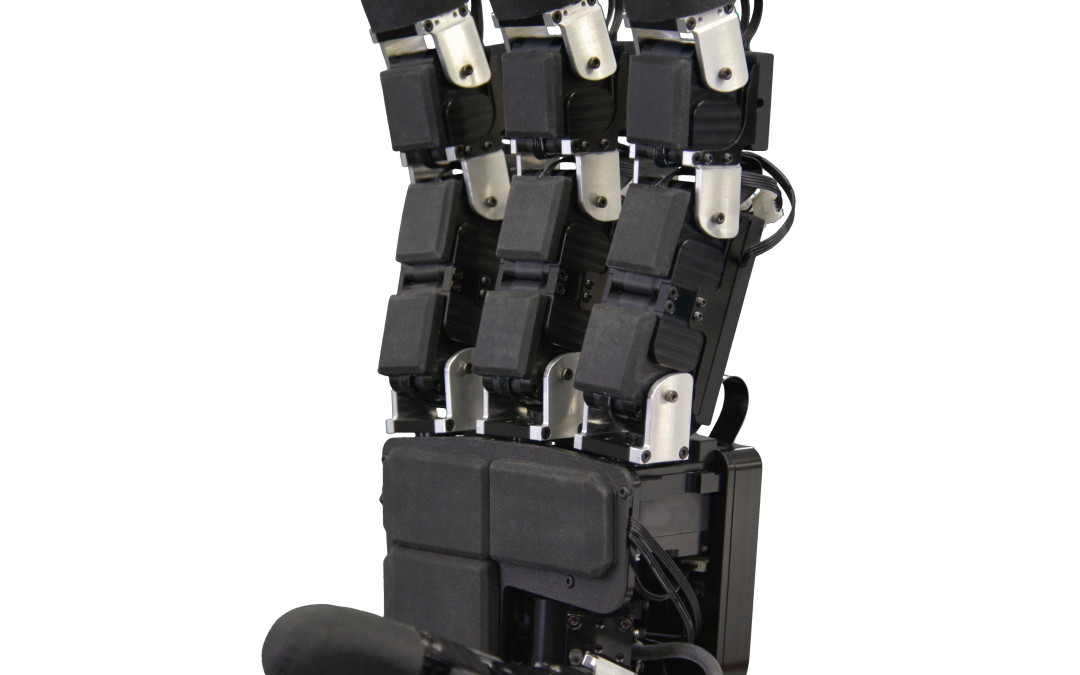
Featured photograph: uSkin tactile sensors integrated on an Allegro robotic hand, photograph by XELA Robotics (24 June 2021), Wikimedia Commons, licensed Creative Commons Attribution-ShareAlike 4.0. Original photograph used illustratively, not T-Rex hardware, Panasonic’s experimental robot or a frame from the researchers’ video.
Recent Comments