
On 26 October 2026, Massachusetts electronics manufacturer CircuitHub publicly unveiled a factory it calls “The Grid”. Its intriguing trick is not a faster pick-and-place head. Instead, levitating carriers route different PCB assemblies among solder-paste, placement, soldering and inspection stations, under software scheduling. The company says it can build a mixed order of 100 different designs without the conventional line changeovers that normally make high-mix, low-volume electronics expensive. That is an unusually consequential idea for anyone developing industrial controllers, sensors or test boards.
One important qualification: the system is an electronics assembly operation, not evidence that bare PCB fabrication, component sourcing and every possible manual process have suddenly disappeared. “No changeovers” is CircuitHub’s description of its production approach, not an independently demonstrated universal capability. The company says The Grid has been operating for paying customers for five years, but only publicly introduced it under that name in October 2026.
What is different from an ordinary SMT line?
In a conventional surface-mount technology (SMT) flow, a batch of identical boards goes through a comparatively fixed sequence: paste print, component placement, reflow, inspection, and sometimes additional soldering or test. Switching product can mean changing a stencil, feeders, programs, recipes or verification parameters. Small batches are therefore disproportionately painful even when the placing machine itself is very fast.
In CircuitHub’s 26 October account, The Grid treats the factory as a coordinated system: levitating movers carry boards and material to the appropriate processes; AI models and conventional optimisation methods decide where work goes next. Each board can take a different route rather than waiting for a whole line to be reconfigured. It is closer to flexible manufacturing with per-unit routing than to a single gigantic robot arm.
That architectural distinction matters. A factory can have excellent individual machines and still waste most of its time waiting for changeovers, material replenishment, a congested oven or an offline inspection station. Routing and scheduling address the losses between machines.
Original-system video: Watch The Grid demonstration on YouTube. GIGAZINE’s 3 November report identifies the clip as released by CircuitHub. We could not independently establish the YouTube account operator or filming date, so treat it as an attributed equipment demonstration, not independent proof of production rate, absence of all manual intervention or the performance claims below. The footage is linked, not downloaded or republished.
The numbers: more interesting than the headline, less universal than an advertisement
CircuitHub gives one concrete comparison: five assembled, four-layer motor-controller boards, with 118 fitted parts per board and 38 distinct component types, delivered to a US address. It quotes US$630 and four days for The Grid, against approximately US$465 and a median nine days from a Shenzhen quick-turn supplier once US shipping and tariffs are included. In this example, the American option costs US$165 more but arrives five days earlier. These are company-supplied figures for one specified job, not an independent audit or a general comparison with Malaysian, Singaporean or Chinese contract assemblers.
Across CircuitHub’s overall business, the company reports more than 2.2 million boards shipped and 150 million components placed. Those are cumulative company figures; they must not be presented as a proven output count for The Grid alone. The company also describes a fivefold capacity expansion plan, which is a forward-looking intention rather than accomplished production.
There is a useful counterpoint. As noted in the independent GIGAZINE coverage, a customer reported a materially less attractive CircuitHub quotation for a different design; CircuitHub’s chief executive acknowledged that pricing depends on whether a board fits the more automated Grid Proto process. This is exactly why procurement engineers must compare their own BOM, layer count, assembly complexity, yields, logistics and revision cycle, rather than extrapolating from a single demonstration quotation.
The embedded engineering underneath a “factory-scale robot”
The software orchestration is the headline; the embedded-control and data-integrity work is what makes the idea operational. Every moving carrier needs a unique identity and a known position. Each station needs a dependable ready/busy/fault handshake. The manufacturing order needs the correct board revision, bill of materials, placement programme, inspection recipe and material genealogy. When a board is diverted around a failed station, the process history must follow it, not vanish into a spreadsheet.
For a real high-mix SMT architecture, we would expect engineering teams to validate at least the following interfaces as part of design acceptance:
- Order to machine: a version-controlled production traveller ties the board serial or panel ID to the released ECAD/BOM revision, process route and authorised firmware or test configuration.
- Station handshakes: PLCs, machine interfaces and industrial gateways exchange machine state, route completion, recipe identity, quality holds and fault codes using the supported native protocols; do not assume every legacy SMT machine speaks OPC UA.
- Inspection and traceability: solder-paste inspection (SPI), automated optical inspection (AOI), reflow profiles and functional-test outcomes are indexed to the same board identity, with timestamps and station/software version.
- Material control: feeder and component-lot verification must still prevent wrong-part placement and flag depleted or unapproved stock. Scheduling cannot correct a wrong reel or a mismatched stencil.
- Exception handling: when a carrier, placement head or inspection station goes offline, the system must hold, quarantine or re-route work under explicit rules, with full operator acknowledgement and an audit trail.
For engineers used to CAN buses and deterministic PLC cycles, the distinction is familiar: a high-level optimiser may decide which job runs next, but that is not permission to put motion safety or time-critical machine stops under a best-effort AI process.
How a CANS solution could make similar factories more dependable
CANS did not build, supply, inspect or benchmark CircuitHub’s factory. The relevant opportunity is to help a different electronics assembler or industrial machine builder implement and validate the practical integration layer behind comparable flexible manufacturing.
Production visibility: CansNEXUS could bring machine availability, WIP locations, blocked-carrier events, changeover time, first-pass yield and board genealogy into a common operations view. MES/OEE logic can distinguish productive run time from waiting for stock, a process recipe or an inspection result, rather than reporting an impressively busy robot that never ships a finished board.
Equipment integration: CANS industrial automation and SCADA engineering could bridge verified SMT machine interfaces, PLC states, AOI/test results and legacy equipment into structured events. Required measurements include station cycle time, reject codes, feeder faults, alarm history, carrier position/status where exposed, recipe checksum and board ID. The integration architecture must be confirmed with machine vendors and the actual installed protocols before anyone promises real-time interoperability.
Earlier detection and recovery: trend rising inspection rejects against specific process recipes, identify queues building ahead of one station, and open a traceable maintenance or quality action before a small fault becomes a shift-long bottleneck. A digital twin or dashboard can help diagnose routing congestion or assess proposed schedules; it does not by itself prove that a schedule is feasible, that every board is good, or that the factory is safe.
Independent protection: safeguarding of moving carriers, robots, ovens and electrical systems still requires properly engineered guarding, interlocks, emergency stops, safe isolation and validated machine-safety functions. Supervisory analytics, AI scheduling, historical OEE and vision dashboards must not replace independent protective controls.
The practical lesson for Malaysian electronics manufacturers
A local high-mix PCB assembler does not need magnetic levitation to learn from The Grid. Start with one measurable loss—perhaps the queue between solder paste printing and AOI—and prove that order identity, station states, inspection outcomes and fault reasons follow each board. Then evaluate whether smarter dispatching, feeder preparation or parallel process routes can remove that loss without compromising traceability or safety.
Industrial automation is often sold as machinery. This story is a reminder that a well-designed manufacturing control architecture can be just as important as the moving hardware. The clever bit is letting different products share resources while keeping each item’s process history intact.
Discuss a high-mix assembly, PLC/SCADA or MES integration project: contact CANS or enquire via WhatsApp. Share the machine list, current protocols, product mix and the particular downtime or traceability problem you are trying to solve.
Sources, demonstration provenance and image credit
- CircuitHub, “Unveiling The Grid”, 26 October 2026 — primary manufacturer description and stated performance/comparison figures; all such claims attributed to the company.
- GIGAZINE, 3 November 2026 — independent report linking manufacturer-attributed footage, with pricing caveats and customer discussion.
- TechRadar Pro, early November 2026 — secondary account distinguishing vendor figures from independently verified results.
- EMSNow, October 2026 — industry coverage of CircuitHub’s high-mix assembly approach and expansion claims.
- Demonstration video, identified by GIGAZINE as CircuitHub-released; uploader account and original recording date not independently authenticated. Video is not reproduced on this site.
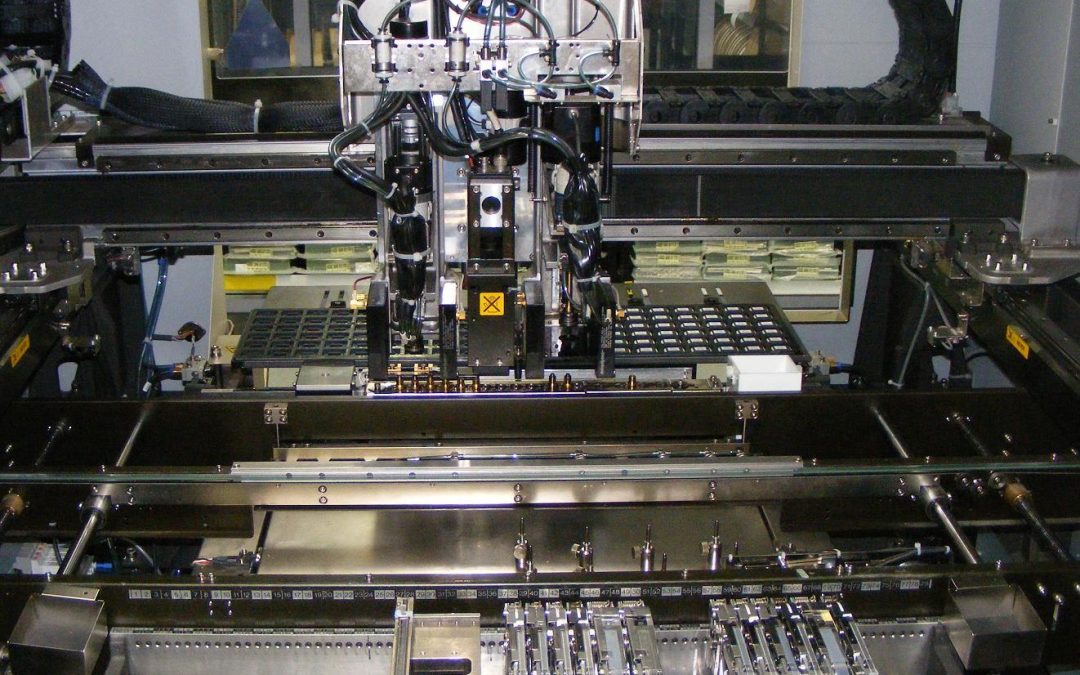
Featured photograph: inside a Juki surface-mount pick-and-place machine, photographed by Peripitus, 3 October 2007, Wikimedia Commons; licensed CC BY-SA 3.0. Unaltered illustrative image, not CircuitHub’s The Grid, a current factory photograph, or a video still.
Recent Comments