
On 31 October 2026, a fire engulfed a mineral-oil recycling facility in Mauá, in the Brazilian state of São Paulo. It began shortly before 5 p.m. in the Capuava district and kept emergency crews engaged into the following morning. Reporters described flames above the roofline, black smoke visible kilometres away and a reported explosion involving a compartment described as containing sódio (sodium). Firefighters were treated for smoke exposure and minor burns. The plant was subsequently declared unsafe and closed by the municipal civil-defence authority.
For an automation engineer, the most important detail may be the least cinematic: the plant’s exact chemical inventory, its layout and the way responders obtain that information matter enormously. A control-room screen cannot extinguish a chemical fire. But an accurate, accessible record of what is stored where — connected to real process alarms and independent protection — can help people recognise danger and respond faster.
Watch the actual fire: publisher video
Watch Metrópoles’ incident-scene video (31 October 2026), or read the original Metrópoles report with its video player.
Video provenance: the clip is carried by Metrópoles in its original news coverage of the Mauá fire. The original camera operator and camera timestamp are not independently authenticated. The footage documents the fire scene; it must not be presented as proof of the first ignition, the source of the reported explosion or the contents of a particular container. The video is linked from its publisher, not downloaded or re-uploaded by CANS.
What is confirmed — and where the reporting differs
Emergency services recorded the incident at approximately 16:52 local time on Saturday, 31 October, at a warehouse on Rua Rosa Kasinski in Mauá. Contemporary reporting identified the site as a facility handling mineral oil. Follow-up reporting by the local Diário do Grande ABC named WPA Ambiental, an oil-recycling business. Firefighters attacked the fire on several fronts; media reports described foam being deployed for the burning material. Smoke and flames were visible from surrounding neighbourhoods, and nearby streets were restricted.
Some outlets reported a peak deployment of 21 fire vehicles, while the municipality’s later site-assessment statement cited 16 vehicles and 61 firefighters. These figures likely reflect different reporting stages or methods; they should not be treated as a single audited final count. Likewise, while flames were reportedly under control late on 31 October, subsequent hotspots needed attention and reporting placed final extinguishment at approximately 09:40 on 1 November — close to 17 hours after the initial call.
Several reports describe an explosion involving a sodium-containing compartment during the incident, together with minor burns and smoke exposure among firefighters. Crucially, reports differ about the sequence: one early account suggests a sodium-related explosion preceded the fire, whereas others place it during firefighting. No final investigation establishing the initial ignition mechanism was available in the sources reviewed. Nor has the identity, chemical form or quantity of the reported “sodium” been independently established here. There is no evidence that a PLC, sensor, motor, pump or operator action caused the fire.
The local civil-defence authority later ordered the entire facility closed after inspecting structural damage. It also reported that residues had reached the roadway and stormwater drains, requiring specialist clean-up and oversight. A factory emergency had become a structural, operational and environmental problem. That broadens the engineering lesson beyond flames alone.
The sodium question is not a small technicality
In Portuguese, the word sódio can refer to sodium, but an incident summary alone does not establish whether the material was elemental sodium metal, a sodium compound or a product labelled in some other way. Those distinctions can change the required emergency response.
For example, NOAA’s CAMEO Chemicals profile for elemental sodium identifies a severe water-reactivity hazard and specifically warns against applying water or foam to that substance. Such guidance does not establish that elemental sodium was present in Mauá or that firefighters used an inappropriate extinguishing method. It illustrates why generic instructions such as “use foam” cannot be applied indiscriminately when a plant contains different hazardous materials. The responsible incident commander needs the exact inventory, safety data sheets (SDS), segregation arrangements and product-specific response plan.
The hidden engineering failure mode worth discussing is therefore information discontinuity: the maintenance department may know which tank was last serviced, purchasing may know which chemical arrived, operations may know which line is running, and the emergency team may have a printed plan that is months out of date. None of those records automatically gives responders a reliable picture of the current hazard.
How a CANS solution could reduce this risk
CANS would not claim its software could have prevented this specific incident. The cause is unknown, and there is no evidence CANS supplied this facility. The technically defensible proposition is more useful: for a similar plant, CANS could integrate operating data, chemical-inventory status, maintenance evidence and emergency information so that developing abnormalities and response gaps are less likely to go unnoticed.
Make the chemical inventory an operational record, not just a spreadsheet
A site-specific CansNEXUS digital-twin and data-integration layer could represent storage tanks, handling bays, pumps, transfer lines, drainage routes, incompatible-material zones, isolation points and emergency access routes. Each critical area could link to an approved chemical register, current SDS, storage limits, inspection status and designated emergency response instructions. Plant personnel would update inventory through controlled work processes and verify it physically; software should not infer an unknown substance from a camera image or automatically classify a reported “sodium” container as sodium metal.
The practical acceptance test is straightforward: can the shift supervisor and incident commander identify the contents and hazards of a specific container without guessing, including during a loss of internet, power or SCADA connectivity? Emergency-critical information needs an offline or independently available copy, not only a dashboard.
Connect the warning signals that genuinely exist
CANS PLC/SCADA and instrumentation integration could trend tank level, transfer-pump status, line pressure, flow balance, overfill events, equipment temperatures, vapour/gas detection where appropriate, fire-panel status and loss of utilities. Properly engineered alarms could highlight a transfer imbalance, overheated pump, unexpected inventory movement or missed protective-device test before it becomes an incident. The sensing method, detection coverage and alarm thresholds must be established through a site hazard assessment, not assumed from the visual appearance of a fire.
Where a rotating pump or motor is a credible risk contributor, PyXis condition monitoring and predictive-maintenance engineering could add vibration, temperature and operating-state trends. These may help catch selected bearing or mechanical deterioration modes. They are not substitutes for certified fire detection, chemical compatibility management or explosion prevention, and a motor fault must never be asserted as the cause here without evidence.
Keep independent protection independent
Shutdown valves, emergency stops, hazardous-area equipment, suitably rated electrical protection, fire detection, suppression systems, containment, segregation and other credited safeguards require their own engineering design and verification. Safety instrumented functions, where applicable, must be designed to the relevant safety lifecycle requirements. CansNEXUS can display their status, record tests and support maintenance follow-up, but a general analytics system or AI recommendation must not become the sole protective layer.
For facilities with potentially water-reactive substances, the documented response plan must identify compatible extinguishing agents and isolation arrangements, coordinated with specialist fire and hazardous-material authorities. SCADA should never prescribe a suppression agent based solely on an unverified chemical label.
Use CMMS records to close the loop
Connecting inspection programmes, hazardous-material storage checks, fire-system test certificates, pump maintenance and corrective work orders into CansNEXUS-supported CMMS workflows could expose overdue safeguards and unresolved defects. A recurring alarm is not resolved just because an operator acknowledges it. Its investigation, work order, repair, independent functional test and sign-off should be traceable to the asset and time of occurrence.
During an emergency, read-only views could help authorised personnel locate emergency access paths, isolation points, spill-containment equipment and documented chemical hazards. After the emergency, synchronised event records can support reconstruction without prejudging the investigation. The municipal report that contaminated residues reached roads and drainage channels also suggests a tangible check for similar plants: are drainage isolation and spill-containment controls mapped, tested, maintained and included in drills?
What this fire teaches plant owners
It would be easy to treat the Mauá footage as another dramatic industrial fire. The harder question is whether a typical facility can answer three questions instantly: what hazardous materials are actually on site, which abnormal signals are being monitored, and which independent safeguards remain operational right now?
A sensible first engineering engagement would review the facility’s verified chemical and equipment inventory, compare it with the as-built piping and drainage layout, identify existing instrumentation and safety layers, and prioritise a small set of actionable alarms and overdue maintenance controls. That is a more credible starting point than claiming an AI digital twin can “eliminate explosions”.
CANS supports industrial automation and SCADA integration, equipment condition monitoring and CansNEXUS plant-data, digital-twin and CMMS integration. For a site-specific engineering assessment, contact CANS or enquire via CANS WhatsApp. Recommendations and protection claims depend on an actual hazard assessment, inspection and commissioning scope.
Incident reporting, original video and image rights
- Publisher video: Metrópoles — Mauá warehouse fire video, published with 31 October news coverage. Scene footage only; original camera operator not independently authenticated; do not infer ignition or chemical contents.
- Municipal civil-defence update: Diário do Grande ABC, 1 November 2026 — total closure of WPA Ambiental, structural damage and drainage-residue clean-up.
- Local follow-up: Diário do Grande ABC, 1 November — firefighting and mopping-up phase.
- Fire-service reporting: UOL, 31 October; Folha de S.Paulo, 31 October, subsequently updated; Metrópoles, 31 October. Vehicle counts and explosion sequence differ between updates.
- Chemical technical reference: NOAA CAMEO Chemicals: elemental sodium (CAS 7440-23-5). Relevant only as a conditional chemical-compatibility example, not confirmation of the Mauá inventory.
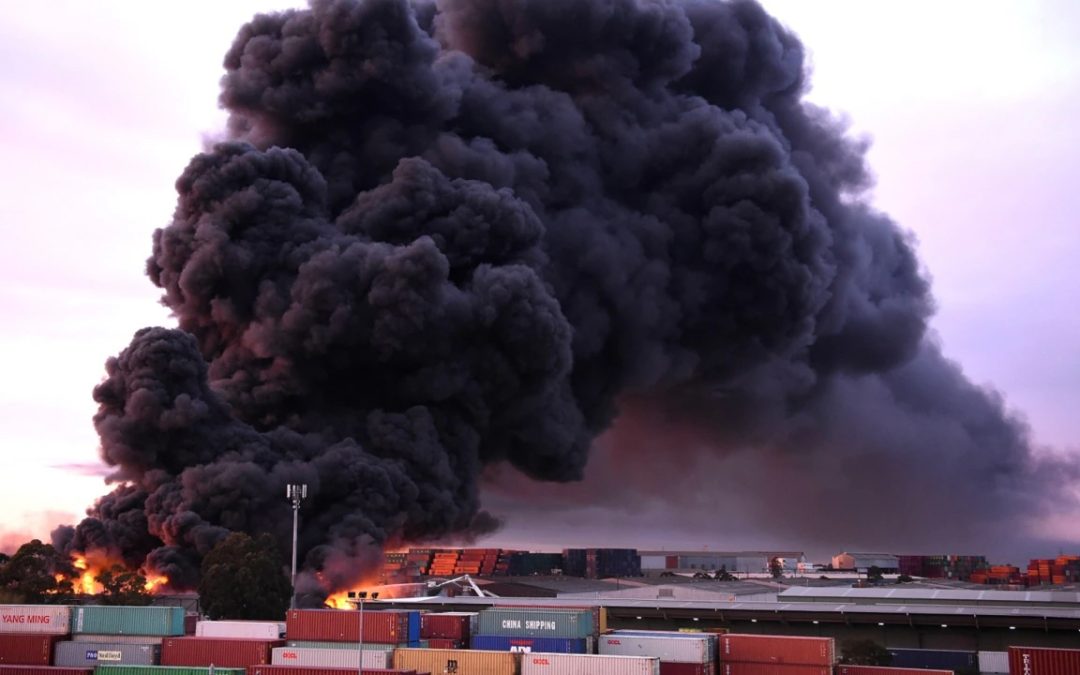
- Featured image: Smoke from the August 2018 West Footscray warehouse fire, Victoria, Australia. Photograph credited to Environment Protection Authority Victoria, made available through Wikimedia Commons under CC BY 4.0. Illustrative historical image, not the 2026 Brazilian incident. No claim of rights to any publisher video is made.
Recent Comments