
Industrial Ethernet has spent years moving downward from the control room towards the field. The awkward part has always been the last few hundred metres. Standard copper Ethernet wants multiple conductors and usually about 100 metres per segment. Traditional field wiring can go much farther, but with much less bandwidth and less direct access to device data.
That is where 10BASE-T1L Single-Pair Ethernet is becoming more interesting. The technology itself is not new, but the standards around it have just moved forward in a way that matters to factory engineers. IEC TS 63444:2026, published on 4 June 2026, now explicitly covers not only Ethernet-APL for process automation, but also 10BASE-T1L with Power over Data Lines for non-intrinsically safe factory and building automation equipment.
There is also a regional signal. At Tech Week Singapore on 29–30 September 2026, vendors are showing IEEE 802.3cg-compliant 10BASE-T1L systems for industrial edge and equipment connectivity. It is still early, but this is moving out of standards meetings and into products that system integrators can actually evaluate.
What 10BASE-T1L actually gives you
10BASE-T1L is Ethernet over one balanced twisted pair. It runs at 10 Mbit/s, full duplex, and the standard is designed for links up to 1,000 metres when the cabling and link budget meet the specification. Power can also be delivered on the same pair using Power over Data Lines, depending on the implementation.
Ten megabits per second does not sound impressive next to gigabit Ethernet, but that is the wrong comparison. A pressure transmitter, remote I/O block, vibration node, smart actuator or environmental sensor does not need gigabit bandwidth. What matters is that the device can sit hundreds of metres away and still participate directly in an Ethernet/IP-based architecture without a fieldbus-to-Ethernet gateway at every boundary.
Ethernet-APL uses 10BASE-T1L underneath, then adds the installation and intrinsic-safety framework needed for process plants and hazardous areas. It is useful to keep those terms separate. Generic 10BASE-T1L SPE is broader. Ethernet-APL is a specific industrial profile for process automation.
| Technology | Typical strength | Where I would use it |
|---|---|---|
| CAN / CAN FD | Robust embedded control, arbitration, low device cost | Machine-level control, mobile equipment, distributed embedded nodes |
| RS-485 / Modbus RTU | Simple, cheap, long reach | Meters, drives, legacy instruments, uncomplicated multi-drop links |
| 100BASE-TX / Gigabit Ethernet | High bandwidth and mature infrastructure | PLC, SCADA, IPC, vision, servers, backbone connections |
| 10BASE-T1L SPE | 10 Mbit/s over one pair, long reach, native Ethernet | Field devices that need richer diagnostics, configuration and data access |
| Ethernet-APL | 10BASE-T1L adapted for process plants and hazardous areas | Process instruments, long trunk/spur installations, intrinsically safe field devices |
Do not replace a working fieldbus just to say the plant is Ethernet
I would not rip out a reliable CAN, Modbus RTU or 4–20 mA installation simply because Single-Pair Ethernet is newer. If a cable already works, use the cable. Migration should start where the existing architecture is creating a real limitation.
A good example is a smart field device that now carries condition data, firmware, diagnostics and configuration information in addition to one process value. The old bus may still be perfectly adequate for the measurement itself, but the extra engineering data becomes awkward. This is where native Ethernet at the field device can reduce protocol conversion and make the asset easier to integrate into SCADA, industrial digitalisation and edge analytics systems.
Another case is a brownfield plant with long cable runs. A standard RJ45 Ethernet retrofit can become messy because 100-metre segment limits force extra switches and power points into the field. A correctly engineered 10BASE-T1L link can stretch much farther over one pair. That does not mean every existing cable is automatically suitable. Cable loss, impedance, EMC, connector choice, grounding and the selected power class still have to be checked.
Where it does not fit
Machine vision is an obvious non-example. Ten megabits per second is not the transport I would choose for high-resolution camera streams. The same applies to high-rate waveform capture, large file transfers and some motion-control architectures. Conventional industrial Ethernet remains the better choice there.
I would also be careful with very low-cost sensors. A simple temperature switch does not become a better sensor because it has an IP stack. CAN, IO-Link, RS-485 or even plain discrete I/O may still be cheaper and easier to maintain.
The value of SPE appears when the device is already becoming a data source, not merely a signal source.
The architecture change is bigger than the cable change
Once Ethernet reaches the instrument, the device is no longer isolated behind a serial gateway. That is useful, but it also means addressing, device identity, firmware management, segmentation and cybersecurity need to be treated properly. Moving Ethernet deeper into a machine or plant without changing the security model simply moves the attack surface deeper as well.
This is the same reason I would not treat 5G, Wi-Fi or Ethernet as interchangeable replacements. The physical layer is only one part of the control architecture. Determinism, availability, maintenance skill, diagnostics and failure behaviour matter more than whether the transport is fashionable.
For brownfield systems, the transition can also be staged. Existing PLC and SCADA layers do not need to be replaced. New SPE-capable instruments can enter through suitable field switches or edge gateways, then expose data through the protocols already used by the plant. The same principle applies when modernising old OPC DA systems towards OPC UA and MQTT. Keep reliable control intact and modernise the interfaces around it.
What I would evaluate before specifying it
For a real project, I would first look at cable distance, number of field devices, power budget, environment, hazardous-area requirements, available PHYs and switches, protocol support, cybersecurity requirements and what data each device actually needs to move. Only then does it make sense to compare installation cost against CAN, RS-485, IO-Link or conventional Ethernet.
The new IEC specification is useful because it makes factory automation a much more explicit part of the 10BASE-T1L discussion. The upcoming Singapore demonstrations are useful for another reason: they let engineers see whether the hardware ecosystem is mature enough for deployment rather than just reading PHY data sheets.
CANS works across embedded systems, industrial communications and automation hardware, so this is exactly the sort of technology we would test against the existing machine architecture before recommending it. If 10BASE-T1L removes gateways, reduces field wiring or gives a device useful diagnostics that were previously inaccessible, it can earn its place. If it does none of those things, I would leave the existing bus alone.
References
- IEC TS 63444:2026 — Industrial networks — Ethernet-APL port profile / Ethernet-SPE profile specification, published 4 June 2026.
- Ethernet-APL project — technology, installation model and 10BASE-T1L basis.
- Tech Week Singapore 2026 — 10BASE-T1L industrial connectivity showcase, 29–30 September 2026.
- Analog Devices — IEEE 802.3cg, 10BASE-T1L and 10BASE-T1S technical overview.
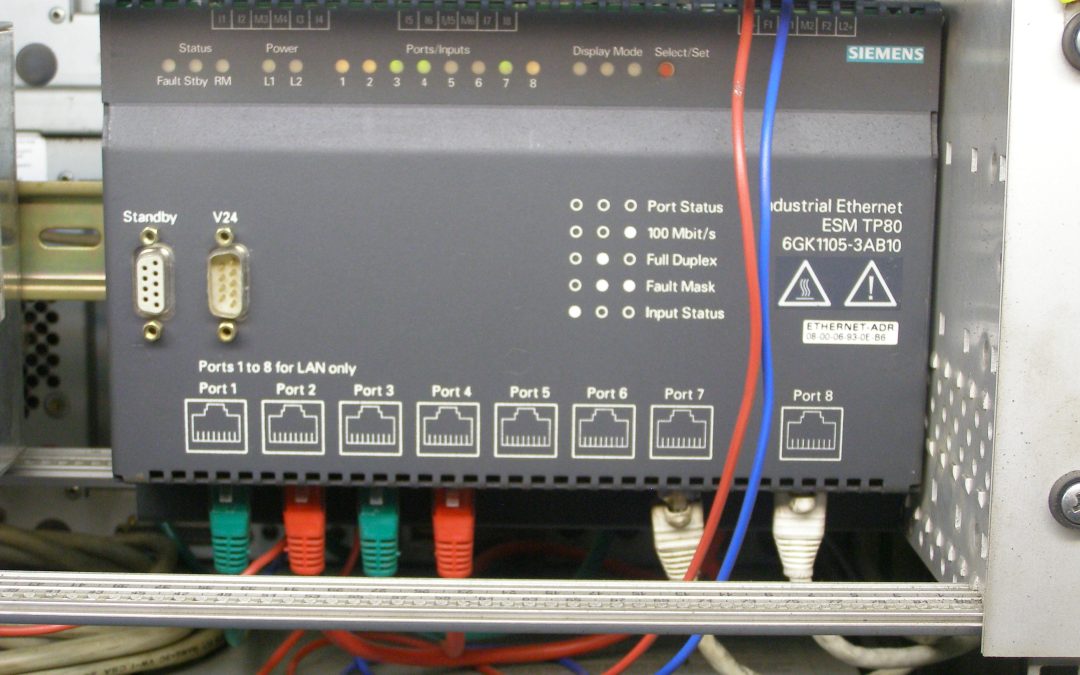
Featured image: Siemens ESM TP80 industrial Ethernet switch. Photo by Mixabest, released into the public domain via Wikimedia Commons.
Planning a brownfield communications upgrade, embedded gateway or field-device integration? Talk to CANS about the architecture or WhatsApp us.
Recent Comments