
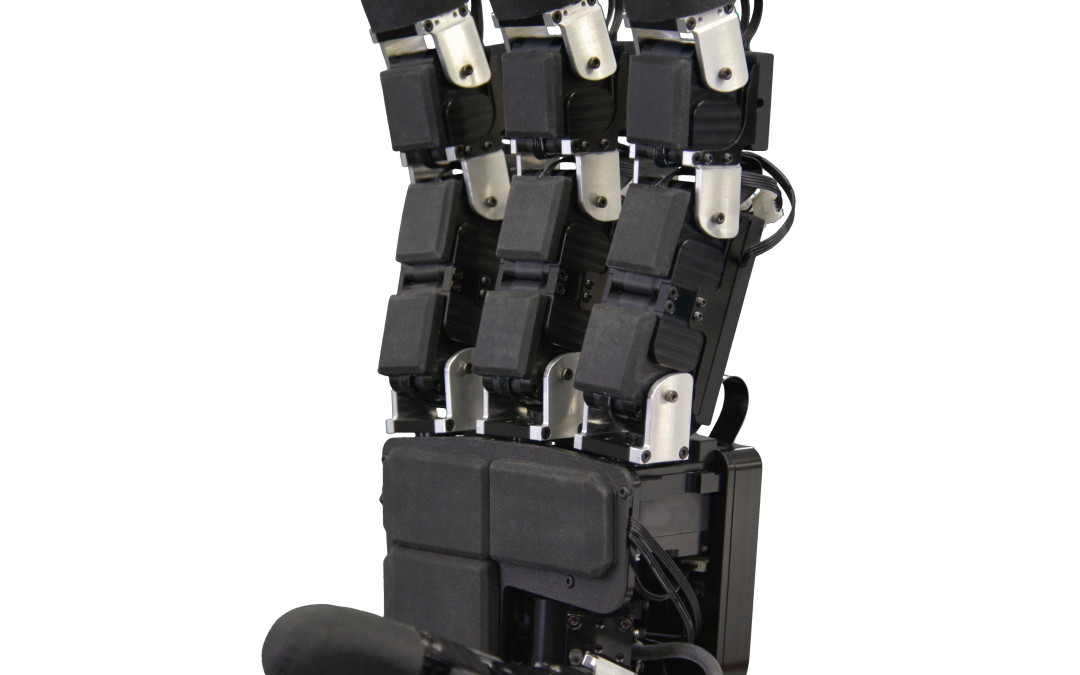
Eighteen motors. Ten tactile sensors. A shared network. Just 100 microseconds for one distributed control period. At electronica 2026 in Munich, Inova Semiconductors, Lattice Semiconductor and the German Aerospace Center (DLR) showed an FPGA-based motion-control demonstrator for a humanoid research hand. The companies announced the work on 9 November 2026, and Inova published its report on 11 November. It is a serious piece of embedded-control engineering, not a claim that a general-purpose AI model can drive 18 motors at 10 kHz.
The headline detail is an architecture in which motor commands can be updated in the same 10 kHz period as the relevant sensor readings. According to the developers, the communication portion between sampling and new target values occupies less than 10 microseconds. That is not a claim that the entire motor servo loop, all computations or a production robot’s safety response takes only 10 µs.
Why saving a single control cycle matters
A controller operating at 10 kHz starts a new period every 100 µs. A conventional distributed scheme may sample the joint position or current in one period, transfer data to a controller and apply a revised target during the following period. The demonstrators say some arrangements introduce as much as two periods of lag.
Waiting one cycle adds 100 µs of discrete-time delay at 10 kHz; waiting two adds 200 µs. The numerical difference looks trivial until a highly compliant multi-axis hand needs stable impedance control, synchronised contact and quick reaction to changing loads. Delay and timing jitter reduce achievable control bandwidth and can make a precisely tuned feedback loop behave poorly. Predictable timing can be more valuable than raw link speed. Exact stability margins depend on the particular motor, sensor, controller and load; the press release does not establish universal performance.
What runs on the FPGA, and what runs on the network?
- Local motor control: DLR-derived field-oriented control is implemented on Lattice FPGAs at the motors, running at a rate above the shared 10 kHz network period. The architecture does not send every switching decision through a central computer.
- Deterministic distribution: Inova’s APXpress carries the synchronised inter-node traffic. The demonstration uses low-power Lattice CertusPro-NX and CrossLink-NX devices and early APXpress samples.
- Different traffic priorities: joint feedback and a ten-sensor tactile array share the network, but tactile-data transfers are scheduled separately so that they do not displace timing-critical motor-control messages.
- Less wiring: the developers use short daisy-chain connections rather than wiring every motor and sensor back to a star-shaped central harness. Around a moving robotic hand, cable mass, fatigue and routing are practical constraints.
The announcement also discusses future carriage of camera and radar traffic. That is an architectural direction, not evidence that a camera-and-radar-equipped production hand has already been qualified. The partners have not published an independent end-to-end safety certification, long-term field-reliability dataset or comparative factory production yield.
Is this better than CAN, EtherCAT or ordinary industrial Ethernet?
There is no defensible one-line winner. CAN/CAN FD, CAN XL, industrial Ethernet and purpose-built serial fabrics address different cost, bandwidth, wiring, scheduling, interoperability and certification constraints. Inova’s reported achievement is a tightly integrated, FPGA-assisted architecture with very short scheduled communication delays. It does not establish that an existing CAN bus, EtherCAT network or PLC is suddenly obsolete.
For an industrial controls comparison, ask for the same measurements on each candidate system: worst-case sample-to-actuation delay, jitter under full sensor traffic, synchronisation error between axes, node-fault behaviour, EMC robustness, cable budget, diagnostic coverage and evidence of safe-state handling. Vendor peak data-rate figures do not answer these questions. A 10 kHz application must be assessed as a whole control system, rather than marketing a single transceiver specification.
How CANS could apply the engineering lesson
CANS’ PLC/SCADA engineering and CansNEXUS platform can help engineers correlate commanded motion, measured position or torque, sensor timestamps, current, faults and machine recipes across automated equipment. On a demanding robotic line, machine vision and MES/OEE event histories could identify whether a recurring reject follows the same motion state or tool-contact condition.
But there is an important boundary. A supervisory dashboard or cloud digital twin is not a 10 kHz servo controller. The fast feedback loop belongs in properly engineered local drives, motion hardware and deterministic networking. CansNEXUS can provide traceability, condition trends, maintenance evidence and production context above that loop. Safety-rated stopping functions, protective circuits and risk-assessed machine safeguards must remain independently engineered and tested. CANS did not design or supply the Inova/Lattice/DLR demonstrator.
If an existing automation system loses accuracy when more sensors or axes are added, start with a measured timing budget and a captured trace of its worst-case behaviour before buying a faster processor. For communications, embedded-control or plant integration support, contact CANS or enquire via WhatsApp.
Evidence and original sources
- Inova Semiconductors, original project announcement, 9/11 November 2026 — the 18-motor architecture, 10 kHz network period, under-10-µs communication budget, FPGA implementation and 10-sensor array. These are developer-reported demonstration results.
- Inova’s official press distribution, dated 9 November 2026 — primary release and associated press photograph.
- Electronic Design, electronica 2026 FPGA report, 19 November 2026 — independent trade coverage of the technology and other exhibits.
Original demonstration video: no authentic publicly accessible video of this specific 18-motor electronica demonstrator was independently verified for this article. The original manufacturer’s release contains the primary description and photographs. No unrelated robot footage is passed off as the demonstration.
Featured photograph: uSkin tactile sensors on an Allegro robotic hand, photograph by XELA Robotics, 24 June 2021, Wikimedia Commons, licensed CC BY-SA 4.0. Unaltered, illustrative photograph; it is not the Inova/Lattice/DLR 2026 demonstrator. The photo is not repeated in the article body.
Recent Comments