
Sand collapsing into a pile, a sheet of cloth folding, water flowing and a protein changing shape do not normally belong in the same simulation package. On 9 November 2026, MIT reported WorldParticle, developed with the University of British Columbia and collaborators: a particle-based transformer architecture evaluated on six very different classes of physical behaviour. The original research was posted as a preprint in May 2026 and is associated with SIGGRAPH Asia 2026; the November report is the recent news development, not the date the research began.
The surprise is not that AI can animate convincing motion. It is that the researchers can use the same model architecture and inference workflow for cloth, elastic solids, Newtonian liquids, non-Newtonian liquids, granular matter and molecular dynamics, instead of engineering a different solver architecture for each.
Watch the researchers’ actual simulation, not a stock-footage explanation
Original source demonstration: WorldParticle full project demo (MP4, hosted on the research team’s project website); researcher project page with the embedded video. Both URLs were checked; the direct MP4 returned HTTP 200. This is a computer-generated research demonstration, not live factory footage or evidence of a commissioned industrial installation. The authors’ page also contains separate animations showing granular collapse, flowing fluids, cloth and molecular-motion examples. We link to the original host instead of copying or reuploading the footage.
What is shared—and what is not
WorldParticle represents the simulated material as Lagrangian particles: tracked points with positions, velocities and other state information. At each step, an explicit predictor advances the particles under known external forces. A learned transformer corrector then estimates the interactions and residual motion. A hierarchical token-merging strategy helps prevent the computational cost of attention from exploding as the particle count grows.
Here is the qualification missing from some breathless interpretations: one architecture is not one universal set of trained weights. The researchers trained separate model parameters for the different physics categories. The study shows that the architecture can be reused across domains and can generalise within tested settings; it does not establish that an unmodified pretrained network will accurately model any new process, plant or material on demand.
There are interesting results. The authors demonstrate granular-collapse behaviour where some comparison methods leave unrealistic floating particles, and MIT reports approximately 100-fold faster protein-dynamics modelling in a particular comparison. But the 100-fold figure involves different simulation-step sizes—50 femtoseconds versus 0.5 femtoseconds—so it should not be read as a universal 100-fold improvement in industrial simulation speed. Accuracy, stability, training data, hardware load, boundary conditions and conservation behaviour remain application-specific.
Nor does this retire CFD, finite-element analysis or discrete-element modelling. Traditional solvers still have well-understood governing equations, material models and verification routes. WorldParticle is a promising research technique, not a certified process simulator or a validated real-time controller.
Why a plant engineer should pay attention
Consider a bulk-handling line where granular material bridges above a hopper outlet, or a soft gripper trying to lift a bag while material shifts inside it. A conventional engineering study may need a discrete-element model for granular flow, structural/contact modelling for the container, and robot kinematics for the manipulator. Those are different representations and often different specialist tools.
A reusable, data-trained particle modelling framework could eventually shorten exploratory studies of coupled behaviour, provided the plant-specific material properties and outputs are calibrated against physical tests. The near-term practical lesson is more modest: when evaluating any fashionable “AI physics” digital twin, insist on held-out validation. Measure the outlet mass-flow profile, pressure or load-cell forces, jamming rate and cycle time against real instrumentation. Run the model at conditions it did not train on. Track systematic error and uncertainty. Beautiful animations are not acceptance evidence.
Where CANS engineering could be useful
For a manufacturer considering a comparable granular or compliant-material process, CANS PLC/SCADA integration could collect time-synchronised hopper weigh-cell readings, feeder motor current, vibration, flow status, actuator position, product identity and jam events. CansNEXUS digital-twin views, trends, alarm histories and MES/OEE records could make those test runs traceable: which recipe and material lot were used, what the independent instruments measured, when blockage occurred and what maintenance action followed.
That instrumentation is the evidence layer. An optional learned simulation layer would have to be separately trained and validated for the actual equipment; CANS is not claiming to supply WorldParticle itself or to have deployed it at the researchers’ institution. The model might help explore recipe changes or candidate machine geometry, but should not be allowed to issue safety-critical machine commands merely because its predictions look convincing.
Detection versus protection: instrumentation, trending and predictive alerts may identify worsening flow or abnormal loading early. Validated control changes and maintenance can reduce nuisance stoppages. Independent motor overloads, safety-rated interlocks, guarding and appropriate process protection must retain authority over hazardous states; neither an AI simulation nor an operator dashboard guarantees the prevention of equipment failure or injury. After an event, historical traces and machine-state records support diagnosis.
The practical result
WorldParticle shows a credible architectural advance: fewer different simulation pipelines may be needed to explore very different physical materials. Its current limits are equally important. Six tested categories are not every industrial process; separately trained weights are not a universal pretrained physics engine; and published research comparisons are not a factory acceptance test.
For machine data, robotics integration and evidence-backed digital-twin development, contact CANS or send a WhatsApp enquiry.
Original sources and visual rights
- MIT News, 9 November 2026 — the researchers’ results, illustrations and qualified claims.
- University of British Columbia, 9 November 2026 — institutional confirmation and research context.
- Wang et al., WorldParticle, arXiv:2605.15305 (May 2026) — technical preprint, including training separation and evaluation limitations.
- WorldParticle authors’ project page — official source demo, model design, examples and code links.
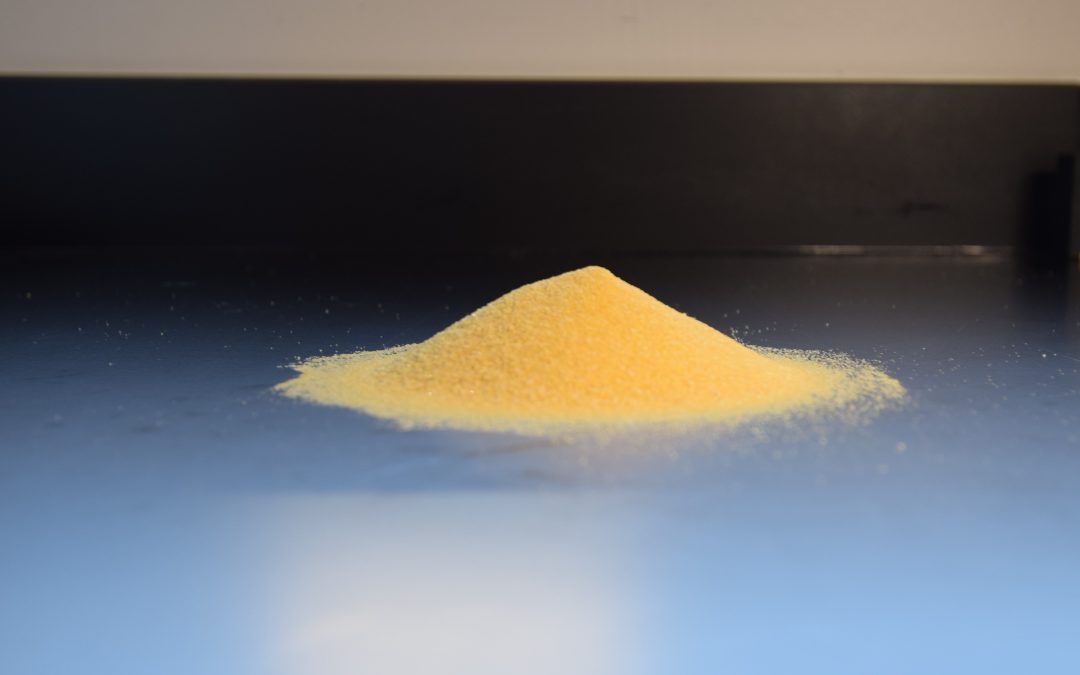
Featured photograph: a real sand pile photographed by CMetz18, 3 December 2018, Wikimedia Commons; CC BY-SA 4.0, used as an illustrative, unaltered photograph. It does not show the WorldParticle simulation, its researchers or a test installation. The featured image is not repeated in this article’s body.
Recent Comments