
Texas Instruments has moved AI assistance beyond code suggestions and into the embedded development workflow. On 10 November 2026, TI announced agentic capabilities for its CCStudio ecosystem that connect software agents with device-specific development material and IDE operations. Its stated workflow covers project configuration, building, programming a target and debugging firmware. That makes the announcement more consequential than another chatbot in a code editor: an assistant can now influence both the compiled binary and the physical test hardware.
TI says its device-migration skill can cut some porting projects from months to days. TI presents that as its own development claim; the announcement provides no independent benchmark, representative migration set or published regression pass rates. Engineers should evaluate the tools against an actual source project, a known target board and an agreed acceptance suite. TI showcased the system around electronica 2026, held 10–13 November in Munich. We found no independently authenticated demonstration video with reproducible test evidence in the primary announcement.
What actually changes inside an MCU development workflow?
The significant engineering mechanism is tool access combined with device context. TI describes Model Context Protocol (MCP) integration that exposes relevant SDK documentation, pin configuration, peripheral information and IDE operations to AI agents. Rather than guessing a microcontroller register definition from generic training material, a properly configured agent can retrieve device-specific information and request actual compiler and debugger operations. That improves the opportunity for grounded changes, while also introducing a new boundary: the agent can alter the toolchain state or flash a board if the engineering environment gives it those permissions.
Device migration remains difficult for concrete reasons. A processor replacement can change clock trees, interrupt priorities, DMA channels, non-volatile memory behaviour, analogue references, watchdog recovery, bootloader addressing, linker sections and peripheral timing. Successful compilation establishes syntax and linkage, while functional correctness requires measurements on the target hardware. Firmware teams should maintain a controlled mapping from every changed hardware dependency to its verification test.
A practical acceptance sequence for agent-assisted firmware migration
- Freeze the baseline: record the original repository commit, compiler and SDK versions, linker map, binary hash, board revision and original device errata. Preserve a known-good recovery image.
- Bound the agent: grant access only to the project and required documentation. Restrict programming, device erase and production credentials to a segregated lab setup.
- Review the hardware delta: compare GPIO electrical modes, pin multiplexing, clock rates, interrupt routing, communication pinout and boot behaviour against the target datasheet and current errata.
- Inspect generated changes: require a human-reviewed diff. Run static analysis, compiler diagnostics and unit tests before programming hardware.
- Measure external behaviour: use an oscilloscope or logic analyser for GPIO timing, PWM dead-time, SPI/I²C/UART waveforms and watchdog recovery. Inject bus errors and controlled power interruptions where the test rig permits them safely.
- Verify regression and rollback: compare time-stamped traces and functional acceptance criteria with the baseline, log every failing test and demonstrate image recovery before field deployment.
How CANS can integrate this approach
For an industrial controller migration, CANS embedded and PLC/SCADA engineers can connect the firmware acceptance suite to the plant interface specification. Capture discrete input transitions, output command-to-feedback latency, fieldbus error counters, watchdog resets, CRC errors, firmware build IDs and configuration checksums. Record deterministic tests at the controller and at the physical terminals; make acceptance depend on measured behaviour rather than generated code volume.
Where appropriate, a CansNEXUS digital twin and MES/OEE integration can correlate firmware release identifiers, communications health, cycle-time distributions and production stoppages. For motors, supplementary PyXis condition monitoring adds real vibration measurements to maintenance trends. The machine’s independent safety functions retain their own verified design and protective authority. CANS does not claim to have supplied or validated TI’s new AI workflow.
What engineering buyers should ask TI
Request a supported-device and SDK matrix, tool permission boundaries, the agent’s action audit log, compatibility with change-control requirements, reproducible offline builds and a migration demonstration on representative firmware. Ask which results TI measured and which claims still need third-party replication. Version control, target-board measurements and signed release approval remain the checkpoints that determine whether a changed controller can enter service.
Primary source: Texas Instruments official release, 10 November 2026. TI’s stated time savings are vendor claims. Video: the primary release supplies no independently verified, reproducible acceptance footage.
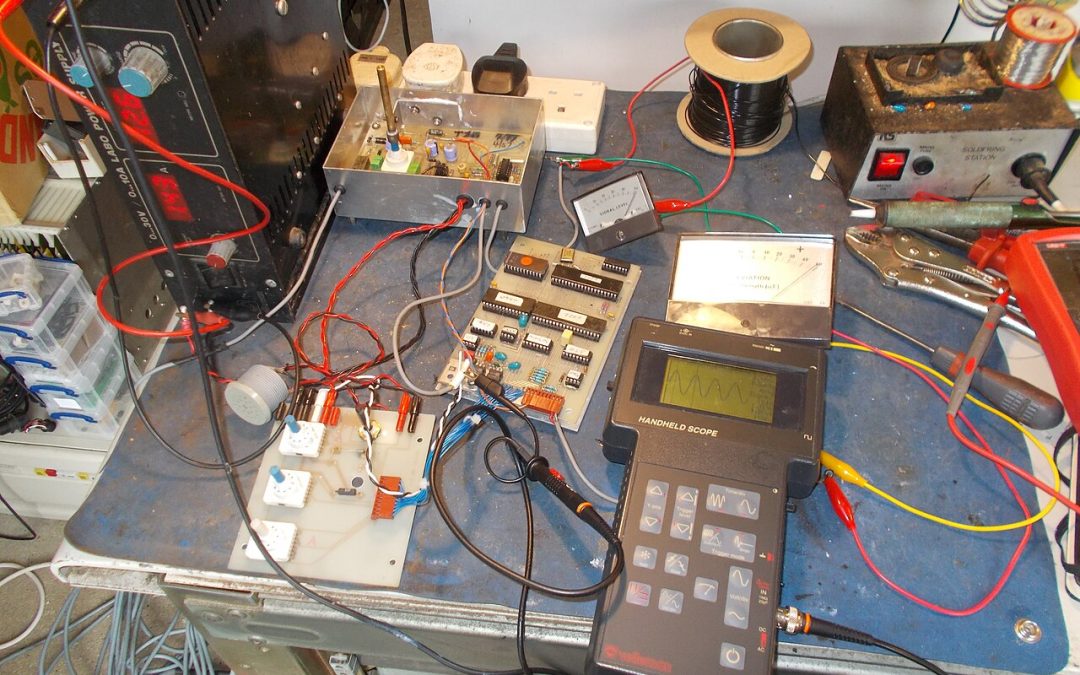
Featured photograph: an illustrative electronics test bench photographed by tony_duell, 12 August 2019, Wikimedia Commons, CC BY 2.0; it shows neither TI CCStudio nor a 2026 development trial.

For a controlled embedded-system migration or PLC/SCADA integration, contact CANS or WhatsApp our engineering team.
Recent Comments