
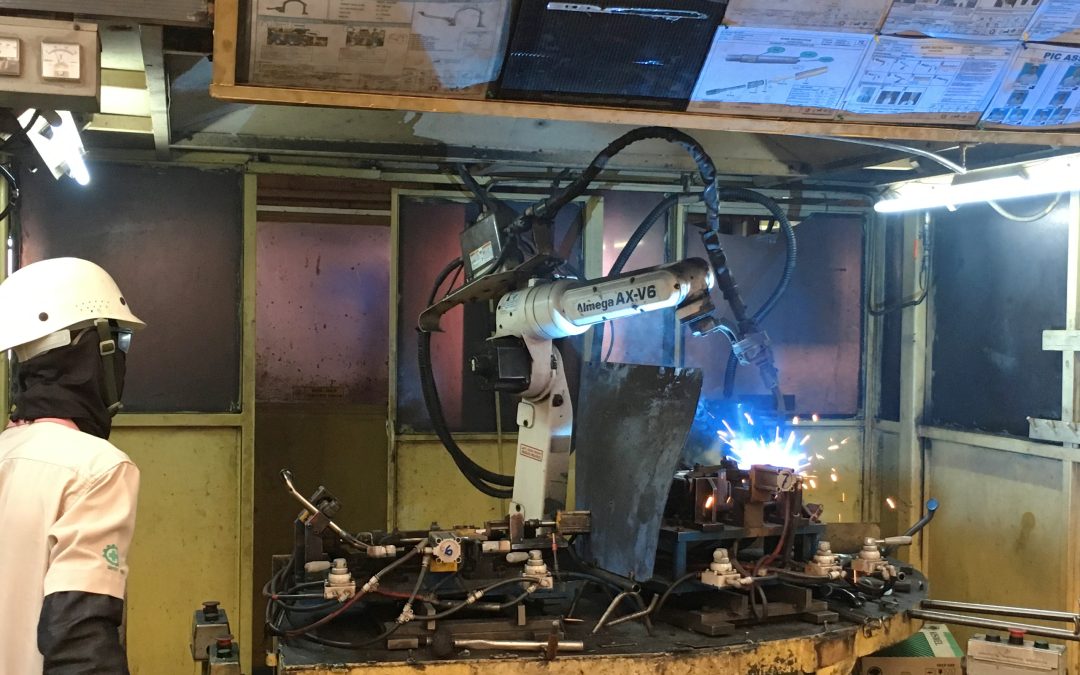
Robotic welding is easy to justify when a factory makes the same part all day. Shipbuilding is almost the opposite: large structures, many variants, awkward access, variable fit-up and work that moves through different stages before the final vessel comes together.
That is why the current push towards “smart shipyards” is worth watching beyond the marine sector. The Financial Times reported on 5 October 2026 that Japanese and South Korean shipbuilders are accelerating robotics and smart-yard automation as they compete with China and deal with labour constraints. Hanwha Ocean says AI now assists 67% of indoor welding at its Geoje yard and that it is targeting full welding automation by 2030. In Singapore, SIT and Seatrium have also opened an Offshore & Marine Digital Learning Lab covering AI, digital twins and other technologies for real yard operations.
The interesting engineering point is not that shipyards are buying more robots. It is that automation is being pushed into a high-mix environment where the workpiece is not always presented to the robot in exactly the same condition. That is much closer to what many Malaysian and Singaporean manufacturers face than a textbook automotive line.
High-mix automation fails when we automate the motion but not the variation
A conventional robot is very good at repeating a taught path. It does not automatically know that a fabricated part has moved 4 mm, that a seam has opened slightly, that distortion has accumulated, or that yesterday’s fixture is no longer holding the next variant in quite the same way.
For welding, the robot path is only one part of the process. The system may also need seam finding or tracking, part identification, fixture-state confirmation, torch condition monitoring, welding-parameter control and a way to stop or escalate when the real joint no longer matches the expected joint.
This is the same problem seen in many high-mix factories. A machine builder can create an impressive robotic cycle for one golden sample, then discover that changeover, material variation and re-teaching consume the expected productivity gain.
I would therefore measure setup time, teaching time, first-piece acceptance, rework and exception frequency alongside cycle time. In a high-mix process, saving 20 seconds per cycle means little if every product change requires hours of engineering intervention.
The workpiece has to become part of the control problem
Smart shipyard projects increasingly combine robotics with production data, sensing and digital models because the controller needs context. In practical terms, that can mean CAD geometry, block identity, work order, weld sequence, seam location and process status being available before the robot starts moving.
A similar architecture makes sense in a factory. Keep deterministic motion and interlocks inside the robot controller and PLC. Put job selection, routing, recipes, traceability and production orchestration above that layer. Use sensing to reconcile the digital instruction with the physical part before allowing the automated process to proceed.
This is where machine vision, laser profiling, dimensional sensing and good fixture-state detection become useful. Vision should not be added because “AI vision” sounds modern. It should solve a defined uncertainty: identify the part, find the seam, confirm orientation, detect a missing component, measure an offset or verify the result.
A useful architecture separates real-time control from production intelligence
| Layer | Shipyard example | High-mix factory equivalent |
|---|---|---|
| Planning | Ship, block and work-package schedule | Production order, batch and routing |
| Digital context | 3D model, block identity, weld definition | CAD/BOM, product variant, recipe |
| Execution | Work-cell job dispatch and progress tracking | MES/work-cell orchestration |
| Control | Robot, welding controller, PLC and safety | Robot/PLC/machine controller |
| Sensing | Seam tracking, position and inspection | Vision, laser, encoder, gauges and sensors |
| Quality record | Weld ID, process parameters, inspection result | Process parameters, serial/batch traceability, inspection result |
The layers should communicate, but they should not be confused. I would not let a scheduling system, AI model or cloud application directly replace safety interlocks or deterministic machine control. If a reliable PLC already owns the machine sequence, leave that responsibility where it belongs and expose controlled interfaces for higher-level systems.
CANS uses the same principle in industrial automation and SCADA work: get the field signals, machine states and control boundaries right first, then connect them into the wider digital system.
Traceability matters as much as robot utilisation
A welding robot that runs for more hours is not automatically producing a better process. In regulated or quality-sensitive fabrication, the useful question is whether the finished joint can be traced back to the correct job, parameters and inspection record.
For a high-mix line, that may mean recording the program revision, process set-points, actual measurements, alarm history, operator intervention and final inspection result against a serial number or batch. Once those records exist, they can support quality analysis, maintenance, OEE and later AI work without turning the control system itself into an experimental data project.
This is one reason the smart-yard direction is broader than robotics. Hanwha describes a real-time Digital Production Center alongside its automation programme, while the SIT-Seatrium lab explicitly includes digital twins and AI for offshore and marine operations. The value is in coordinating the physical work, not merely adding another robot arm.
Where I would start in a Malaysian or Singaporean factory
I would not begin by asking how much of the factory can be automated. I would pick one product family or fabrication step where skilled labour is scarce, setup effort is high and quality variation is measurable.
- Capture the current cycle, setup, teaching, rework and inspection effort.
- Identify which variation prevents straightforward robotic repetition.
- Add the minimum sensing required to resolve that variation.
- Keep machine and safety control deterministic.
- Connect job identity and process results to the production record.
- Run enough variants to prove that changeover and exception handling are genuinely better.
If the cell works only when the most experienced engineer is standing beside it, it is not yet a scalable automation system.
For larger programmes, a plant-level platform such as CansNEXUS can sit above existing PLC, SCADA and machine systems to organise production context, OEE, maintenance and digital-twin information without replacing reliable control. The wider CANS industrial digitalisation and automation portfolio covers the field-to-software integration around that architecture.
Robots are becoming useful in places that used to be considered too variable
Shipyards are a useful benchmark because they expose the limits of conventional fixed automation very quickly. Large parts move. Fit-up is imperfect. Product mix is high. Work is distributed over a large site. Skilled trades remain important. If robotics can deliver value there, the lesson for general manufacturing is not “automate everything”. It is that sensing, context, traceability and exception handling are making automation viable in processes that were previously too variable to justify.
That is the part I would carry into a high-mix factory project. Do not start with the robot. Start with the variation that defeats the robot, then engineer the sensing, control and production data around it.
Discuss a high-mix automation project with CANS
CANS works on PLC/SCADA, robotics integration, machine communications, machine vision, production data, digital twins and industrial AI for manufacturing and infrastructure systems in Malaysia and Singapore.
Send CANS an enquiry or WhatsApp CANS on +60 12-295 9602 to discuss an automation, robotic-cell or industrial digitalisation project.
References
- Financial Times, 5 October 2026 — Japanese and Korean shipbuilders deploy robots to take on China.
- Hanwha, 21 July 2026 — Inside the smart yards modernizing global shipbuilding.
- Singapore Institute of Technology, 11 February 2026 — SIT and Seatrium Launch Offshore & Marine Digital Learning Lab.
- Featured image: Welding Robot Facility — Antoniusaw / Wikimedia Commons, CC BY-SA 4.0.

Recent Comments