
Humanoid robots are starting to move from trade-show demonstrations into real industrial work. The timing is relevant for this region: Industrial Transformation ASIA-PACIFIC 2026 in Singapore opens on 21 October with a keynote on physical AI, humanoid and cognitive robotics.
The harder engineering question is no longer whether a robot can recognise a tote, walk to a station or learn a new motion. It is what happens when the perception model is wrong, a person steps into the path, a sensor is occluded, the network drops, or the robot carries something heavier than the original trial.
I would treat a humanoid the same way I treat any other machine that can create hazardous motion: the AI may decide what task to attempt, but it should not be the only thing preventing injury.
Recent humanoid designs are moving safety into a separate layer
Agility Robotics unveiled Digit 5 on 15 September 2026. The company describes safe human detection using multiple sensors and AI, visual and audible safety cues, and an independent safety controller that supervises the robot’s response when a person gets too close.
That separation is more interesting to me than the humanoid form factor. A general perception or planning model can be updated frequently and can behave probabilistically. A safety function has a different job: detect a hazardous condition, move the machine to a defined safe state, and do it within a known response time.
Agility also notes that Digit 5 remains in development and that some safety features are still under development. That is an important qualification. The current generation of humanoids should be evaluated as industrial machinery with evolving capabilities, not as a finished replacement for conventional automation.
AI perception is useful, but it is not automatically a safety function
A vision model can identify people, pallets, forklifts and obstacles. A motion planner can find another path. A large model can interpret a task such as “move these totes to line 3”. All of that can improve flexibility.
None of it automatically makes the safety chain trustworthy.
In a conventional robot cell, the safety architecture may include guard switches, light curtains, area scanners, safety PLCs, safety-rated speed monitoring, emergency stops and Safe Torque Off. These devices are selected and validated against defined safety requirements. A neural network that performed well in a demonstration is not equivalent to that.
| Layer | Typical role | How I would treat it |
|---|---|---|
| Task AI / planner | Choose task, sequence or route | Allowed to act only inside a bounded operating envelope |
| Perception AI | Identify people, objects and free space | Useful input, but not the sole protective layer unless implemented as a validated safety function |
| Motion controller | Generate trajectories and actuator commands | Supervised by independent limits and safe-stop mechanisms |
| Safety controller | Stop or limit hazardous motion | Deterministic, safety-rated and independent from general AI behaviour |
| Emergency stop / drive safety | Remove or control hazardous motion | Direct, predictable and testable |
The standards picture is still catching up with humanoids
ISO 10218-1:2025 covers safety requirements for industrial robots, while ISO 10218-2:2025 addresses industrial robot applications and cells, including integration, commissioning, operation and maintenance.
Humanoids complicate the familiar picture because they may be dynamically stable, mobile, work outside a fixed cell and share space with people. Agility says it is contributing to ANSI/A3 work for dynamically stable industrial mobile robots and to ISO 25785-1, a humanoid safety standard that is still under development.
That does not mean factories should wait for every standard to settle. It means the integrator has to be conservative. Risk assessment must cover the actual application, not just the robot model.
Five things I would test before allowing a humanoid into normal production
1. Stopping behaviour with real payloads
Measure stop distance and stop time at the maximum permitted speed and payload, including a degraded case such as poor floor grip or a partially obstructed sensor. The safe distance around the robot should be based on measured behaviour, not the nominal walking speed in a brochure.
2. Independent detection of people and unsafe zones
Onboard cameras and AI perception are useful, but shared industrial spaces usually need another independent view of risk. That may be safety scanners, safety-rated vision, zone monitoring or another validated architecture. NVIDIA’s Halos for Robotics reflects the same direction: separate safety infrastructure around AI-enabled robots, including safety compute, software and external sensing concepts.
3. Fault behaviour when communications disappear
A humanoid linked to WMS, MES or a fleet manager will eventually lose a connection. Decide in advance what it does. Does it stop, finish the current move, return to a safe location, or continue locally? The answer should depend on the hazard, not on what is convenient for the cloud software.
The same principle applies to other mobile automation. In our earlier article on WMS, AS/RS and AMR integration, we argued that the supervisory system should coordinate work without taking away the machine’s local responsibility for safe behaviour.
4. Task boundaries and software authority
I would let a higher-level system issue bounded commands such as “collect tote 123 from station A and deliver it to station B”. I would be much more cautious about exposing unrestricted motion, drive or PLC write access to an AI agent.
CANS covered the same authority problem in AI Agents and Industrial Control. General-purpose AI can assist with diagnosis, planning and workflow, but the final control and safety paths should remain constrained and auditable.
5. Recovery after an abnormal event
Factories rarely fail in neat ways. A tote drops, a door is blocked, a person presses an emergency stop, the battery reaches a low threshold, or another vehicle parks in the recovery zone. A pilot should prove how the robot is made safe, how it is reset, who is authorised to recover it and what happens to the unfinished task in WMS or MES.
Where humanoids may make sense first
The strongest early applications are not necessarily tasks where a six-axis robot already works well. If a cable and a fixed robot solve the problem, use them.
Humanoids become more interesting where the plant was built for people and cannot easily be redesigned: moving totes between existing workstations, tending machines with human-oriented controls, handling mixed manual logistics, or operating across several low-volume tasks that do not justify a dedicated robot cell for each one.
Even then, I would start with a low-energy, repetitive material-handling task in a controlled area. Prove uptime, recovery, human interaction and maintenance burden before expanding into faster motion, heavier payloads or tools that create cutting, crushing, thermal or electrical hazards.
A useful pilot is an engineering test, not a stage demonstration
A factory pilot should generate evidence. I would log at least stop events, near misses, perception confidence, route interventions, manual recoveries, charging cycles, fault codes, task completion, mean time between intervention and the exact reason a human had to step in.
That data matters commercially as well as technically. A humanoid that completes 95% of tasks but needs a technician every hour may be less useful than a simpler AMR or fixed automation cell. Flexibility is valuable only when the operating and support burden is acceptable.
For Malaysian and Singapore plants considering physical AI, the design work is therefore broader than choosing a robot. It includes plant layout, safety functions, machine interfaces, WMS/MES integration, network resilience, cybersecurity and maintenance procedures.
Sources
- Industrial Transformation ASIA-PACIFIC 2026 — programme, 21–22 October 2026, Singapore
- Agility Robotics — Digit 5 announcement, 15 September 2026
- NVIDIA — Halos for Robotics, 22 June 2026
- ISO 10218-1:2025 — Robotics — Safety requirements — Industrial robots
- ISO 10218-2:2025 — Robotics — Safety requirements — Industrial robot applications and robot cells
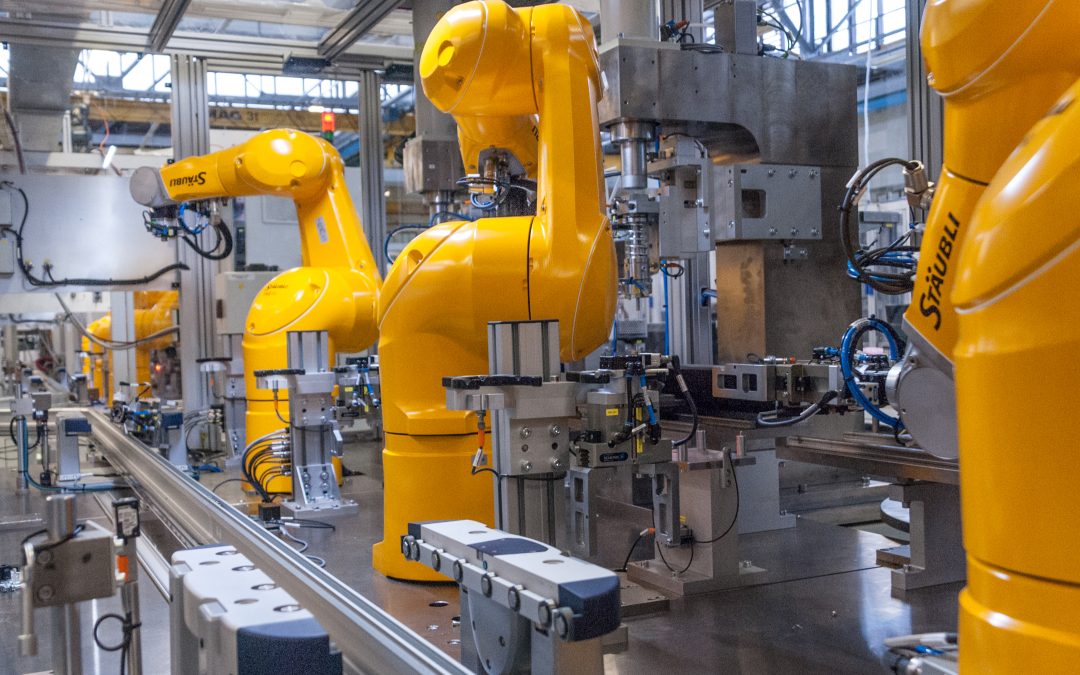
Featured image: “Stäubli Robots line” by Clemenspool, CC0 1.0.
Engineering support
CANS works on industrial automation, embedded systems, machine communications, robotics integration, PLC/SCADA, MES/OEE and industrial AI. If you are evaluating humanoid robots, AMRs or another form of physical AI, we can help define the control, safety and integration boundaries before the pilot grows into a production system.
Recent Comments