
Edge AI is moving down another layer. Instead of putting every model on an industrial PC or gateway, vendors are starting to run inference inside the communications module itself.
Telit Cinterion announced on 8 September 2026 that its new Edge AI SDK will run LiteRT models directly on selected 4G, 5G RedCap and higher-performance 5G modules, with the first SDK release expected in Q4 2026. The idea is straightforward: the modem already has an application processor, memory, Linux and a secure path to the cloud, so why add another processor if the model is small enough?
For industrial IoT, that is more interesting than it sounds. It can reduce board count, power, integration work and the amount of raw data that has to cross the cellular link. But it also creates a new coupling between communications, inference and field-update lifecycle. I would use it selectively, not automatically.
The modem is becoming a small edge computer
Telit’s September announcement is a useful marker because it supports standard .tflite models rather than requiring a proprietary model format. The company says the runtime is embedded into module firmware and executes on the module’s own application cores. That puts lightweight inference in the same device that already handles cellular connectivity.
A few days later, Ambarella announced its X7 standalone AI accelerator for Arm and x86 hosts. Its stated use case includes existing cameras, gateways and industrial controllers that need AI capability without redesigning the underlying host platform. BrainChip was also demonstrating battery-powered edge-AI applications at Embedded World North America in September, including radar classification and presence detection running entirely on-device.
These products are not the same architecture, but they point in the same direction: inference is being pushed closer to the sensor and the field device rather than treated as something that must live in a server room or cloud account.
Where this actually helps
Remote industrial equipment is the obvious case. Think pumps, motors, generators, substations, utility panels, tanks, mobile assets or isolated skids where cellular is already part of the design.
If the device is sending raw vibration, audio, current waveforms or high-rate telemetry continuously, the communications cost and data-management burden can become larger than the useful information. A small local model can convert that stream into something more meaningful before transmission: normal, abnormal, bearing-like signature, cavitation-like signature, overload, unusual acoustic event, or simply a confidence score and feature set.
That fits naturally with condition monitoring and predictive maintenance. I would still keep the signal-processing path deterministic. Sample the sensor properly, calculate the features you trust, run the model on top of those features where appropriate, and only send raw waveforms when there is an event worth investigating or when engineering staff deliberately request them.
The same idea applies to simple machine-state classification, energy-pattern recognition, remote asset health and local event filtering. It is less attractive for heavy machine vision, large multimodal models or anything that needs a GPU-class memory subsystem.
A useful split between control and inference
I would not let a cellular AI module become the primary controller for a machine simply because it now has an ML runtime. Communications hardware reboots. Cellular sessions drop. Linux services hang. Models also fail in ways that deterministic PLC logic usually does not.
A better arrangement is to keep the control path separate:
| Function | Best place | Reason |
|---|---|---|
| Interlocks, trips, sequencing | PLC, MCU or safety controller | Deterministic behaviour and clear failure modes |
| High-rate acquisition | MCU, DSP or dedicated acquisition hardware | Precise timing and efficient signal handling |
| Small inference / event classification | MCU, cellular module or compact edge processor | Low latency and reduced upstream data |
| Fleet analytics, model training, cross-site comparison | Server or cloud platform | More compute, storage and historical context |
| Maintenance workflow and operational context | MES, CMMS or industrial platform | Turns a prediction into an actual work process |
If the AI module disappears, the machine should continue to operate safely. That single design rule avoids a lot of future trouble.
The trade-off is not only compute
Putting AI inside the modem can remove a processor, but it also concentrates several responsibilities into one component. That affects product lifecycle.
Before committing to the architecture, I would check model size, RAM headroom, CPU load during modem activity, thermal behaviour, inference latency, Linux process isolation, watchdog behaviour, update rollback, secure boot, signing of model files and how long the module family will remain supported. A design that saves one processor today but becomes impossible to maintain after a modem generation change is not a saving.
For field equipment in Malaysia and Singapore, cellular certification and operator compatibility matter as well. If the application needs 5G RedCap, make sure the commercial network and module variant actually match the deployment area. There is no benefit in specifying the newest radio mode when LTE already gives adequate coverage and data rate.
If a cable already works, use the cable. If a small local model can prevent a remote device from shipping useless raw data all day, use the model.
What I would deploy first
The first applications I would put on this kind of architecture are modest ones:
- anomaly detection on vibration, current, acoustic or temperature features;
- machine-state classification for remote assets;
- event filtering so only useful records are transmitted;
- simple local quality or condition scoring where the sensor is already digital;
- connectivity-aware buffering and store-and-forward decisions.
I would not start with autonomous process optimisation or safety-related control. Those need stronger validation, clearer authority boundaries and a more deliberate system architecture.
Singapore’s Tech Week on 29–30 September 2026 is also showing current commercial interest in this area. One exhibitor is promoting multi-modal equipment intelligence using vibration, power, sound and vision sensing for predictive maintenance. That is a buyer-interest signal rather than proof that every implementation works, but it matches what we are seeing technically: more processing is moving towards the field device.
For machine builders and industrial OEMs
The opportunity is not to put “AI” on the specification sheet. It is to remove unnecessary hardware and bandwidth while improving what the device can tell you.
For a new embedded product, I would compare three architectures early: inference in the MCU, inference in the communications module, and inference in a separate edge processor. The answer depends on sensor bandwidth, model complexity, power budget, field-update requirements and how long the product has to stay supported.
CANS works across embedded and industrial hardware, industrial digitalisation, condition monitoring and higher-level platforms such as CansNEXUS. For a product or remote-monitoring design, we can review the sensing, embedded processing, communications and backend together instead of treating them as separate purchases.
Discuss an embedded or industrial IoT project with CANS or WhatsApp CANS.
References
- Telit Cinterion, 8 September 2026 — Edge AI SDK for selected 4G and 5G modules.
- Ambarella, 15 September 2026 — X7 standalone edge-AI accelerator.
- BrainChip, 15 September 2026 — ultra-low-power on-device AI demonstrations.
- Tech Week Singapore 2026 — equipment intelligence and predictive-maintenance showcase, 29–30 September 2026.
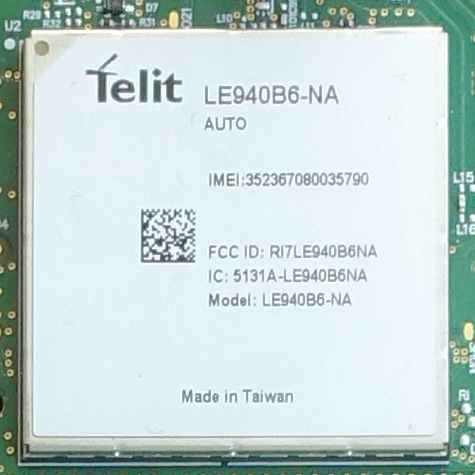
Featured image: Telit LE940B6-NA LTE module photographed by Steve Jurvetson, CC BY 2.0, via Wikimedia Commons. The photograph predates the 2026 SDK announcement and is used only to illustrate the cellular-module form factor.
Recent Comments