
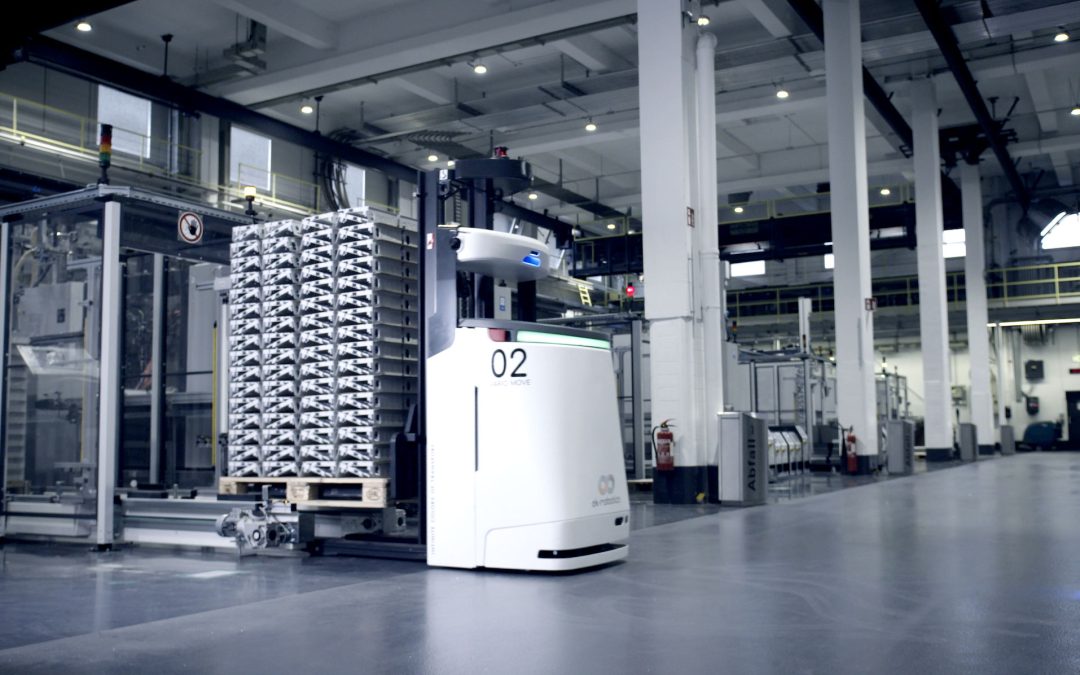
5G is starting to turn up in real factories and warehouses, not just demonstrations. That does not mean it belongs everywhere. In many machines, a cable is still the simplest and most reliable answer.
The timing is notable. At the GSMA M360 ASEAN Manufacturing and Production Summit in Kuala Lumpur on 10 September 2026, the manufacturing agenda centred on moving smart manufacturing from isolated pilots to repeatable deployment. GSMA highlighted AI as the largest expected share of digital investment across ASEAN enterprises, with IoT, analytics and next-generation connectivity close behind. The same summit explicitly positioned 5G as an enabler for low-latency control, predictive maintenance, asset tracking, worker safety and secure industrial data flows.
I would not replace a working wired control system just because 5G is available. If the machine is fixed and Ethernet, CAN or fieldbus already does the job, leave it alone. 5G earns its place where equipment moves, cabling is awkward, or the application genuinely needs wireless bandwidth.
Why industrial 5G is timely in Malaysia
Malaysia now has a live industrial reference rather than only demonstrations. In June 2026, CelcomDigi launched what it described as Malaysia’s first industrial B2B live use case powered by 5G Standalone (5G-SA): an Advanced Intelligent Warehouse in Shah Alam.
The deployment integrates a warehouse management system, automated pallet storage and retrieval, 5G-connected AGVs, AI visual surveillance, autonomous inventory drones and a digital-twin platform. CelcomDigi reported a 30% improvement in space utilisation, more than 50% improvement in operational efficiency and inventory precision of up to 100%. Those figures are vendor-reported and specific to that implementation, so they should not be assumed as generic 5G returns. What matters is the architecture: mobile automation, AI vision, WMS and digital-twin functions are being operated together over a live industrial 5G-SA environment.
That direction also matches the broader message from M360 ASEAN: factories are increasingly buying connectivity as part of an integrated automation and data architecture rather than as a standalone telecommunications upgrade.
Singapore is already using 5G with digital twins and industrial automation
Singapore provides a useful parallel. In January 2026, IMDA highlighted DSV’s 5G-enabled warehouse digital twin at its Red Lion facility. The system combines real-time digital-twin visualisation with computer vision and augmented-reality functions, using 5G connectivity to move operational data from the warehouse into a common digital environment.
IMDA has also cited 5G-enabled Industry 4.0 work with ST Engineering and logistics operators, including collaborative robots, warehouse digital twins and other industrial applications. Singapore’s 5G programme has therefore moved well beyond consumer mobile broadband into enterprise operations.
What I expect to see more often is 5G being considered together with AGVs and AMRs, mobile vision, edge computing, WMS/MES and digital twins. That is where it starts to make sense—as part of the application, not as a telecom project on its own.
Where industrial 5G adds genuine value
5G becomes compelling when the application has one or more of the following characteristics.
1. Moving machines and mobile assets
AGVs, AMRs, autonomous forklifts, mobile robots, inspection vehicles and portable operator stations are awkward to cable. Industrial Wi-Fi can serve many of these applications, but 5G-SA can offer controlled mobility, SIM/eSIM-based identity, centralised policy and potentially stronger service differentiation when the network is engineered correctly.
2. High-bandwidth uplink from cameras and vision systems
Machine vision increasingly produces large upstream data flows rather than the predominantly downstream traffic typical of office networks. A moving inspection camera, autonomous drone or mobile quality station can benefit from 5G where installing fibre or Ethernet is impractical.
Before sending video across the plant, I would first ask whether it needs to leave the camera area at all. In many cases, edge AI can process the image locally and send only the result, alarm or selected evidence. See CANS’ edge-AI machine vision article for more on that architecture.
3. Brownfield areas where cabling is expensive or disruptive
Running new industrial Ethernet through an operating plant can involve shutdowns, cable trays, hazardous-area considerations, civil works and difficult routing. A well-engineered wireless layer can reduce the cost of adding non-critical sensors, mobile assets or temporary monitoring in brownfield environments.
4. Temporary or rapidly reconfigurable production
Manufacturers increasingly reconfigure cells, lines and intralogistics paths. Wireless connectivity can make temporary stations, test rigs and mobile equipment easier to move without redesigning the physical network every time.
5. Remote support, AR and digital-twin interaction
High-resolution video, augmented-reality support and live digital-twin views can require consistent bandwidth and low enough latency for practical interaction. Here again, 5G can be useful—but the result depends on the complete data path, not only the radio link.
Keep the wires where they make sense
5G should not be sold as “wireless Ethernet for everything”. There are several areas where established wired networks remain the sounder engineering choice.
Hard real-time motion and safety
Servo motion, coordinated drives, safety I/O and high-speed interlocking depend on deterministic timing, proven failure behaviour and mature diagnostics. Industrial Ethernet technologies such as EtherCAT, PROFINET IRT and EtherNet/IP CIP Motion, together with purpose-built safety protocols, remain the normal choice for these functions.
Wireless 5G may carry supervisory data around such systems, but putting a safety-critical motion loop across a wireless network requires a much stronger engineering and certification case.
Fixed PLC-to-I/O and controller networks
If a PLC and remote I/O rack are fixed two metres apart inside a control panel, replacing a cable with 5G creates cost and complexity without solving a real problem. The same applies to many Modbus, CAN, CAN FD and industrial Ethernet links inside machines.
CANS’ embedded and industrial networking work therefore treats cellular connectivity as another layer in the architecture—not a reason to remove proven machine-level networks. CAN and CAN FD remain particularly appropriate for robust distributed embedded control where device cost, wiring simplicity and deterministic arbitration matter.
Systems that must remain simple for decades
Factory networks often outlive multiple generations of IT infrastructure. A simple, documented wired control network can remain maintainable for 15 to 20 years. A wireless architecture introduces radio planning, subscription or spectrum arrangements, SIM lifecycle, firmware, cybersecurity policy and dependency on a 5G core. Those are manageable—but they are real lifecycle obligations.
5G latency is an end-to-end property, not a marketing number
One of the most common mistakes in industrial 5G projects is to focus on the radio specification and ignore the application path.
Actual response time depends on the radio interface, 5G core, routing, backhaul, edge or cloud location, application processing, gateway conversion and the industrial protocol itself. A fast radio connection can still deliver poor control performance if data travels to a distant cloud region before returning to the plant.
For latency-sensitive industrial workloads, the architecture often needs 5G Standalone plus local or nearby edge computing. PLC control should generally remain local. The 5G layer should move the data that benefits from mobility, bandwidth or flexible deployment while edge applications perform vision, analytics, digital-twin synchronisation or local orchestration close to the process.
A mixed architecture usually makes more sense
In most factories I would mix the technologies:
- machine level: CAN/CAN FD, IO-Link, Modbus RTU, EtherCAT, PROFINET, EtherNet/IP or other proven control networks;
- cell/line level: industrial Ethernet connecting PLCs, IPCs, drives, HMIs and edge gateways;
- mobile/high-bandwidth layer: industrial Wi-Fi or 5G for AGVs, AMRs, mobile cameras, drones, tablets and temporary instrumentation;
- edge layer: protocol conversion, buffering, AI inference, cybersecurity boundaries and local applications;
- operations layer: SCADA, historian, MES, WMS, CMMS, OEE and digital-twin services;
- enterprise/cloud layer: ERP, analytics, cross-site reporting and selected AI services.
This is the same principle behind industrial digitalisation: modernise the information architecture without destabilising the control architecture.
Where multiple systems need to exchange production, warehouse and maintenance data, CANiS Integration Server can provide the integration layer between industrial systems and business applications. For operational visualisation, analytics and digital-twin functions, CansNEXUS provides a higher-level framework for connecting live plant data to digital operations.
Before spending money on industrial 5G
I would start with the engineering requirement, not a coverage map or a handset speed test.
- Define the use case. AGV control, video uplink, worker communication, temporary sensors, remote support and digital twins have different network requirements.
- Set measurable performance limits. Specify acceptable latency, jitter, availability, handover behaviour, uplink bandwidth and recovery time.
- Perform an RF survey. Steel structures, machines, racking, moving loads and process equipment can create difficult radio environments.
- Decide what stays local. Keep control loops, safety functions and essential production logic close to the machine unless there is a compelling reason not to.
- Design the edge boundary. Determine which data is processed locally and which is sent to MES, WMS, digital twin or cloud applications.
- Plan cybersecurity. Device identity, SIM/eSIM management, segmentation, firewalls, remote access, certificates, patching and logging must be part of the OT design.
- Engineer failure modes. Decide what the AGV, robot or operator system does when coverage is degraded or the 5G core is unavailable.
- Integrate the operational systems. Connectivity alone does not improve OEE or inventory accuracy. PLC, WMS, MES, SCADA and analytics data must be joined into an operational workflow.
- Measure the business result. Track throughput, travel time, labour exposure, inventory accuracy, downtime, quality, changeover time and network availability—not merely Mbps.
Do not buy the 5G first
A factory can install excellent 5G coverage and still gain very little if the connected application is poorly selected. Conversely, a modest wireless deployment around one constrained mobile process can have a strong return if it removes cabling, manual travel or production interruptions.
I would not begin with “5G-enable the factory”. Pick one job where wireless actually removes a constraint, for example:
- connect a fleet of AGVs or AMRs;
- add mobile AI vision where cable routing is impractical;
- connect a warehouse digital twin to moving assets;
- instrument a brownfield area without major shutdown work; or
- provide reliable mobile connectivity for maintenance and remote expert support.
Once that use case is proven, the network can be extended based on measured requirements rather than technology enthusiasm.
How I would approach it
At CANS, I would treat 5G as one more layer in the plant architecture, not a replacement religion. The job is still to make the embedded devices, PLCs, wired control, mobile equipment, edge systems and production software work together and remain maintainable.
For a factory considering industrial 5G, that normally means starting with the application and working backwards: identify the moving or high-bandwidth workload, retain the wired control systems that already work, add the appropriate gateway/edge layer, integrate the resulting data into MES/WMS/OEE or digital-twin functions, and then validate the operational benefit.
Send CANS an enquiry or contact CANS on WhatsApp to discuss an industrial connectivity or smart-manufacturing project in Malaysia or Singapore.
References
- GSMA — M360 ASEAN 2026 Manufacturing and Production Summit, Kuala Lumpur, 10 September 2026
- CelcomDigi — Malaysia’s first industrial 5G-SA-powered Advanced Intelligent Warehouse, 9 June 2026
- IMDA — DSV Pioneers 5G-Enabled Digital Twin for Next-Generation Logistics Management, January 2026
- IMDA — Building Singapore’s capabilities through 5G
- Wikimedia Commons — ek robotics AGV VARIO MOVE, ek robotics GmbH, CC BY-SA 4.0
Recent Comments