
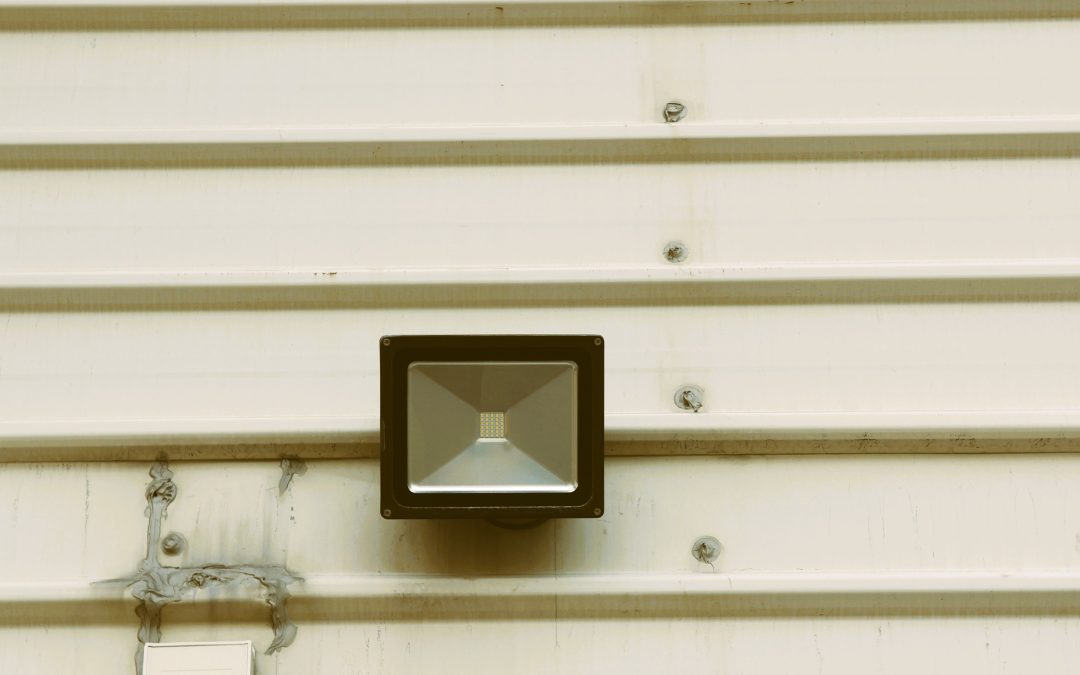
A camera that works perfectly in a home, office or retail shop can still become an expensive weak point when it is installed beside a production line, in a warehouse yard, on a utility plant, near variable-speed drives or outdoors in tropical weather.
The reason is not simply image resolution. In industrial applications, the camera is part of an operational system: power, network, storage, cybersecurity, environmental exposure, analytics and integration all matter. A cheap camera can therefore be good value in the right location, while the same camera can create repeated maintenance calls, blind spots or integration problems in the wrong one.
The practical rule is not “industrial camera everywhere”. It is to classify the environment and consequence of failure first, then buy the minimum camera and infrastructure that meet those requirements.
“Industrial CCTV” is not one universal equipment class
Procurement specifications often use the labels residential, commercial and industrial as if they were formal standards. They are not. There is substantial overlap. Some relatively low-cost cameras now offer IP66 housings, PoE, RTSP and ONVIF, while some enterprise security cameras add wide temperature ranges, IK10 impact resistance, secure boot, signed firmware, industrial-grade cybersecurity functions and stronger environmental design.
That means the buyer should compare the actual specification rather than the marketing category.
| Typical class | Where it can make sense | Typical limitation to check |
|---|---|---|
| Residential / low-cost smart camera | Office corners, reception, non-critical indoor observation, temporary monitoring, low-consequence areas | Temperature, power arrangement, Wi-Fi dependence, firmware lifecycle, account/cloud dependency, VMS interoperability, storage architecture |
| Commercial / enterprise CCTV | Warehouses, offices, building perimeter, car parks, general plant surveillance, logistics areas | Whether environmental, EMC, vibration and cybersecurity requirements match the actual plant location |
| Rugged / industrial-grade camera | Outdoor process areas, hot or dusty production zones, vibration-prone locations, utilities, mobile equipment, harsh or high-consequence installations | Higher purchase cost; avoid over-specifying it for benign areas |
Why apparently cheap cameras become expensive in plants
The camera price is usually only one component of lifecycle cost. In a factory or utility environment, the larger cost can be the technician call-out, access equipment, troubleshooting time, lost evidence, repeated reconfiguration, network changes and replacement of a discontinued model.
A useful total-cost model is:
TCO = camera + lens/mount/enclosure + power/network + VMS/NVR/storage + licences + installation/access + firmware/cybersecurity maintenance + expected failure and downtime cost.
A RM300 camera that needs three site visits can easily cost more than a better-specified unit installed once. Conversely, putting a premium rugged camera in every air-conditioned office corridor is poor engineering economics.
1. IP and IK ratings: necessary, but not enough
An IP rating addresses ingress of dust and water. An IK rating addresses mechanical impact. These are useful, but they do not tell you whether the camera will tolerate electrical noise, repeated vibration, corrosive atmosphere, UV exposure, condensation, poor grounding or an unstable network.
For example, current rugged network cameras are available with combinations such as IP66/IP67, IK10 and operating ranges around -40°C to +60°C. The AXIS P1475-LE is one example, specified with IP66/IP67, IK10, electronic image stabilisation, secure boot and signed OS. This is very different from assuming that any camera marked “outdoor” is automatically suitable beside industrial equipment.
For Malaysia and Singapore, also consider the real local micro-environment. A shaded warehouse wall, a rooftop enclosure and a steel pole in direct sun can have very different camera temperatures even on the same site.
2. Temperature and condensation matter more than the brochure headline
Check the operating temperature, not storage temperature. Also check humidity and whether the rating assumes non-condensing conditions. Outdoor cameras may need sunshields, proper cable glands, breather arrangements or housing design to manage thermal cycling and condensation.
Low-cost equipment is not automatically unusable. For example, TP-Link’s Tapo C325WB is a consumer-oriented product that nevertheless lists IP66, ONVIF, RTSP, PoE and an operating range of -20°C to +45°C. That may be entirely adequate for a benign covered location. It is less persuasive for a hot process area, vibrating structure or high-consequence perimeter point.
3. Vibration: image stabilisation and mechanical survival are different questions
Vibration can blur the image, loosen the mount or damage connectors and internal assemblies over time. Electronic image stabilisation helps with image quality, but it does not prove that the camera is mechanically qualified for continuous vibration.
For cameras mounted on machinery, cranes, vehicles or vibrating steelwork, ask for the applicable shock/vibration test data and use suitable mounts and connectors. If the requirement is machine inspection rather than general observation, a dedicated machine-vision camera may be more appropriate.
4. EMC and EMI: the invisible difference between a building and a factory
Factories contain variable-frequency drives, contactors, welders, large motors, switching power supplies and long cable runs. A camera may pass normal commercial EMC requirements yet still behave poorly in a harsh installation with bad earthing, surge coupling or noisy power.
For difficult areas, ask what industrial EMC immunity standards the camera, PoE equipment and power system have been evaluated against, and design the installation accordingly. In many cases the biggest improvement comes from the infrastructure: screened or correctly routed cabling, fibre uplinks, managed switches, proper bonding, surge protection and separation from power circuits.
5. PoE and network resilience are part of the camera system
PoE simplifies installation, but “supports PoE” is not a resilience specification. Check the actual IEEE 802.3af/at/bt class, switch power budget, cable distance, temperature derating and restart behaviour after a brownout.
For critical plant cameras, consider:
- managed industrial or enterprise PoE switches rather than unmanaged desktop switches;
- UPS-backed switching and NVR/VMS infrastructure;
- surge protection for exposed copper runs;
- fibre where long outdoor links or severe EMC exposure justify it;
- VLAN segmentation and controlled routing;
- SNMP or equivalent monitoring of switch and link health;
- edge recording where loss of the uplink must not create an evidence gap.
6. Cybersecurity: an IP camera is an OT/IT endpoint
Every connected camera adds firmware, credentials, services and network exposure. For industrial deployments, cybersecurity should be evaluated with the same seriousness as any other networked OT device.
Useful requirements include secure boot, signed firmware/OS, HTTPS/TLS, 802.1X where appropriate, disablement of unused services, individual credentials, documented vulnerability handling and a credible firmware-support period. Avoid direct internet exposure of camera management interfaces.
Singapore buyers have an additional useful procurement signal in the Cyber Security Agency of Singapore’s Cybersecurity Labelling Scheme (CLS) for consumer IoT products. Current listings show IP cameras at different CLS levels; for example, several Axis models are listed at Level 4 while various VIGI models are listed at Level 1. This does not replace a full industrial cybersecurity assessment, but it is better than treating all connected cameras as equivalent.
7. ONVIF and RTSP: interoperability needs to be specified properly
RTSP gives you a video stream. That is useful, but it does not by itself give you standardised analytics metadata, events, PTZ controls or lifecycle interoperability.
ONVIF Profile T is now the more appropriate baseline for advanced video streaming. ONVIF announced in October 2025 that support for the older Profile S will end and recommends Profile T as its successor. Profile T covers H.264/H.265, imaging settings, alarm/tamper events, metadata streaming and HTTPS-related functionality for conformant products.
For industrial analytics and IIoT integration, ONVIF Profile M is particularly relevant because it standardises metadata and analytics events, including interfaces for object classification, counters and MQTT event handling where implemented.
This distinction matters commercially: a camera may stream excellent video to an NVR yet still be difficult to integrate into an operational platform because the useful metadata is locked inside a proprietary application.
8. Edge AI: ask what leaves the camera
“AI camera” is now a broad marketing term. The engineering question is not merely whether the camera can detect a person, vehicle or helmet. Ask:
- Can the analytics event be exported through ONVIF, MQTT or a documented API?
- Can object counts and classifications be read without using the vendor’s cloud?
- Can rules be configured centrally?
- Can the event be correlated with PLC, SCADA, MES or IIoT data?
- What happens when the NVR, cloud or WAN connection is unavailable?
If the objective is operational intelligence rather than only security, accessible metadata is often more valuable than an impressive mobile-app demo.
9. Low-light, HDR and optics: megapixels are not enough
Industrial scenes commonly combine bright doors, dark machine interiors, reflective metal, welding arcs, headlights and rapidly moving objects. Resolution alone does not solve these problems.
Compare sensor size, lens quality, aperture, wide dynamic range, minimum illumination, IR behaviour, shutter controls and motion performance. A lower-resolution camera with better optics and dynamic range can provide more useful evidence than a higher-megapixel camera producing blurred or clipped images.
10. Latency: CCTV is not automatically a machine-vision system
For operator verification, remote observation and process review, normal IP-camera latency is often acceptable. For closed-loop control, precision inspection or deterministic triggering, it may not be.
If the application requires hardware trigger inputs, strobe synchronisation, deterministic exposure, dimensional measurement or guaranteed response time, specify an industrial machine-vision architecture rather than trying to force a CCTV camera into that role.
11. Retention, NVR and redundancy: design the recording system, not just the camera count
Storage capacity should be calculated from resolution, frame rate, codec, scene complexity, recording mode and required retention period. A 30-camera system designed around guessed bitrates can quickly become either undersized or unnecessarily expensive.
For high-consequence systems, consider the failure modes of the NVR/VMS, storage array, network core and uplinks. RAID is not the same as a complete backup or redundant recording architecture. Edge SD recording can provide useful failover, but only if recovery and synchronisation are actually supported and tested.
12. Hazardous areas require certified equipment
Where flammable gas, vapour or combustible dust creates a classified hazardous area, a normal “weatherproof” camera is not enough. The complete camera installation must suit the hazardous-area classification and local engineering requirements.
Certified explosion-protected cameras are available. As one example, Axis specifies the Q1961-XTE thermal camera for certain Zone 2/21 and Division 2 applications with ATEX/IECEx/cULus certifications. The correct device depends on the actual zone, gas/dust group, temperature class and installation method. This is an area where procurement by price alone is particularly risky.
Practical selection matrix for Malaysian and Singapore industrial users
| Application | Usually acceptable | Minimum engineering checks |
|---|---|---|
| Air-conditioned office inside plant | Residential or commercial | Cybersecurity, retention, network access, lifecycle support |
| Clean indoor warehouse | Commercial; selected low-cost models for non-critical points | PoE, ONVIF Profile T, low-light, NVR compatibility, mounting height and maintenance access |
| Production floor near drives/motors/conveyors | Robust commercial or industrial | EMC, vibration, temperature, PoE resilience, network segmentation |
| Outdoor yard / utilities / process area | Outdoor enterprise or industrial | IP66/67, temperature, UV/sun load, lightning/surge, corrosion, low-light/HDR, fibre where justified |
| Camera mounted on vibrating machine or mobile equipment | Rugged industrial / transport-qualified | Shock/vibration qualification, connectors, mount, stabilisation, local recording |
| Security-critical perimeter or remote site | Enterprise or industrial | Redundant recording, health monitoring, cybersecurity, UPS, edge failover, long-term firmware support |
| Hazardous-area process zone | Certified explosion-protected equipment only | Zone/division, gas/dust group, temperature class, certified glands/enclosure/install method |
| Machine-vision-adjacent monitoring | CCTV for observation; dedicated vision camera for measurement/control | Latency, trigger, exposure, optics, repeatability, metadata/API, lighting |
Buyer checklist before issuing the PO
- What is the actual minimum/maximum camera ambient temperature?
- Is the location wet, dusty, corrosive, exposed to sun or subject to washdown?
- Is there sustained vibration or shock?
- What are the relevant EMC and surge conditions?
- Is PoE backed by an appropriately rated managed switch and UPS?
- Does the camera support ONVIF Profile T, and Profile M if analytics metadata is needed?
- Are RTSP, MQTT or vendor APIs documented and usable without cloud lock-in?
- What secure-boot, signed-firmware, TLS and 802.1X capabilities are provided?
- How long will firmware and vulnerability support be available?
- How will video be retained, recovered and monitored if an uplink or NVR fails?
- Does the optics/sensor combination suit the real light and motion conditions?
- If the area is hazardous, is the complete installation appropriately certified?
Where CANS fits
CANS does not need to manufacture the camera to add engineering value around the camera system. In industrial digitalisation projects, the important work is often at the boundaries: reliable OT networking, edge integration, event handling, data correlation and bringing useful camera or analytics information into the wider operating context.
Where cameras expose suitable interfaces, CANS can integrate video-system events and metadata with CruxNEXUS industrial intelligence, IIoT/SCADA architectures and AI vision / machine-vision solutions. The design should be based on open interfaces such as ONVIF, RTSP, MQTT or documented APIs wherever practical, rather than assuming every camera can provide the same data.
Planning CCTV or AI-vision integration for a factory, warehouse or utility site? Send CANS an enquiry or WhatsApp CANS on +60 12-295 9602.
Dr Tang’s View
My view is that buying the most expensive camera everywhere is as wasteful as putting a home camera into a harsh process area. Classify the environment and the consequence of failure first, then specify the minimum environmental, network, cybersecurity and integration requirements. In most industrial sites, the camera price is a small part of lifecycle cost once access, cabling, outages and integration are included.
CAN Technology Watch — 31 August 2026
- CANopen FD: CiA’s latest CAN Community News, dated 21 August 2026, reports that CiA 1302-1 and CiA 1302-2 additional CANopen FD application-layer documents have been finalised and entered CiA’s internal document-quality process.
- CAN XL and security: CiA is planning a new CAN XL webinar series and, at the August iVT Expo, highlighted CANsec (CiA 613-2) as the cybersecurity data plane for CAN XL together with current CANopen Safety developments.
- Engineering tools: Kvaser’s 2026 CanKing 7.5 update adds J1939 and ISO-TP annotators, improving practical protocol-aware trace analysis. HMS/Ixxat continues to position CAN XL as the next step for higher-payload, mixed-network architectures.
Sources and further reading
- ONVIF Profile T — advanced video streaming
- ONVIF Profile M — metadata and events for analytics applications
- ONVIF — Profile S support ending; Profile T recommended
- Axis P1475-LE technical specifications
- Axis Q1961-XTE hazardous-area camera example
- TP-Link Malaysia Tapo C325WB specifications
- Cyber Security Agency of Singapore — Cybersecurity Labelling Scheme
- CAN in Automation — CAN Community News No. 11, 21 August 2026
- CAN in Automation — iVT Expo 2026 CAN technology update
- Kvaser — CanKing 7.5 and May 2026 software release
- HMS/Ixxat — CAN XL technical overview
Recent Comments